Teide Cable Car: Tickets, Prices and How It Works
The Teleférico del Teide lifts you from 2,356 m to 3,555 m in about eight minutes — the fastest way to get within touching distance of the highest point in Spain. It is also Tenerife’s most heavily booked attraction, it closes without much warning when the wind picks up, and the ticket alone does not get you to the actual summit. This guide covers all of it: every ticket type, verified 2026 prices, the refund rules, and exactly what you can reach at the top without a permit.
How the Teleférico actually works
The base station sits at 2,356 m on the TF-21, the road that crosses Teide National Park, on the stretch between the El Portillo visitor centre and the Parador — much nearer the Parador end, a few minutes’ drive short of it. The upper station, La Rambleta, is at 3,555 m on the shoulder of the summit cone: 1,199 vertical metres in about eight minutes, a faster altitude gain than almost anywhere else in Europe, which matters more than most visitors expect (more below).
It is operated by Volcano Teide, the official concession holder, on a timed-slot system: your ticket is for a specific date and ascent window, not a turn-up-and-queue pass. Entry to the national park itself is free — you are paying for the ride, not the park.
One thing worth saying up front, because it catches people out constantly: the cable car does not go to the summit. From La Rambleta you are still 160-odd vertical metres below the 3,715 m crater rim (you will also see 3,718 m on older maps and signs, but modern surveys settled the official figure at 3,715 m). That final stretch, the Telesforo Bravo trail (no. 10), needs a separate permit with limited daily places — covered in detail further down this page.
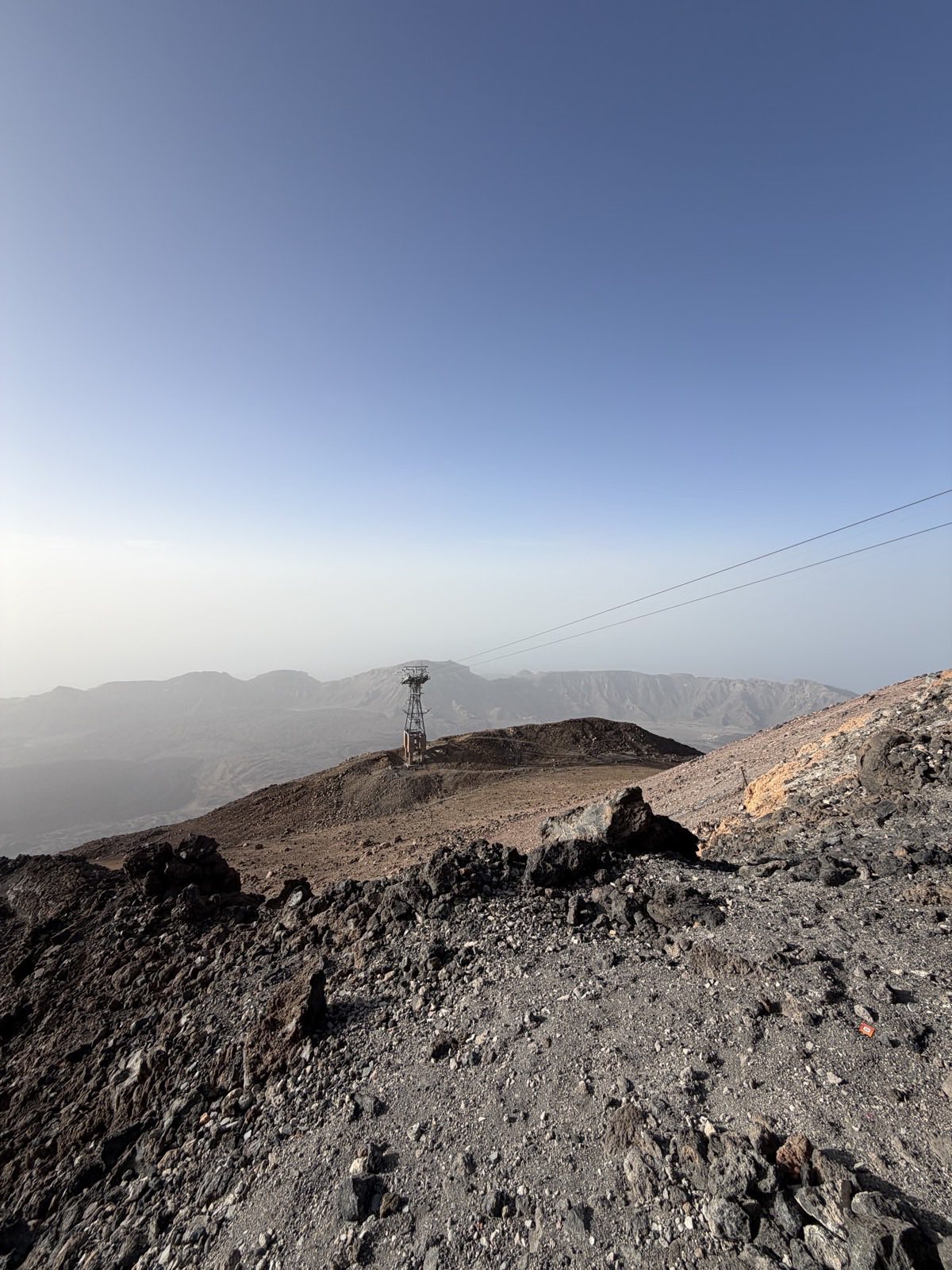
The pylon photo at the top of this page is one I took in July 2026 on the walk near the upper station, having come up on foot overnight — even mid-morning in high summer, the wind across that ridge had real bite.
Ticket types and 2026 prices
These are the prices shown on the official Volcano Teide prices page as of July 2026. Note that Volcano Teide’s booking calendar uses “from” pricing, so on some dates you may see a euro or two more than the base figures below — treat this table as a reliable guide and confirm the live price for your date at checkout.
| Ticket | Adult (non-resident) | Child 3–13 (non-resident) | Who it suits |
|---|---|---|---|
| Return (up and down) | €42 | €21 | Most visitors |
| Single ascent only | €23.50 | €11.75 | Hikers walking down Montaña Blanca |
| Single descent only | €23.50 | €11.75 | Hikers who climbed up on foot |
| Return + Teide Legend audio guide | €45.50 | €24.50 | First-timers who want context |
| Return + guided Pico Viejo viewpoint walk | €54.50 | €33.50 | Guided short walk at the top (no under-5s) |
| Cable car at sunset | from €72 | no under-8s | Sunset above the clouds, capped at 90 people |
A few notes on those:
- Children under 3 are not allowed to ride at all — not a pricing quirk but a health rule, because of the altitude.
- Canary Islands residents get heavily discounted fares on every ticket type (documentation checked at the turnstile), including one-way legs at €5.88 for adults.
- The one-way tickets are the hiker’s tool. If you are climbing Teide on foot via Montaña Blanca (trail 7), a single descent ticket saves your knees 1,200 m of downhill scree. If the walk up doesn’t appeal but the walk down does, ride up on a single ascent and descend on foot. Our hiking guide covers both routes.
- The sunset service runs on limited days (Tuesday, Friday and Sunday at the time of writing), capped at 90 people, no under-8s, with times shifting through the year to match sunset. A fuller “Sunset & Stars” package adds coach transport from the north or south of the island, a picnic dinner and telescope stargazing after dark — see our stargazing guide for how those evenings work.
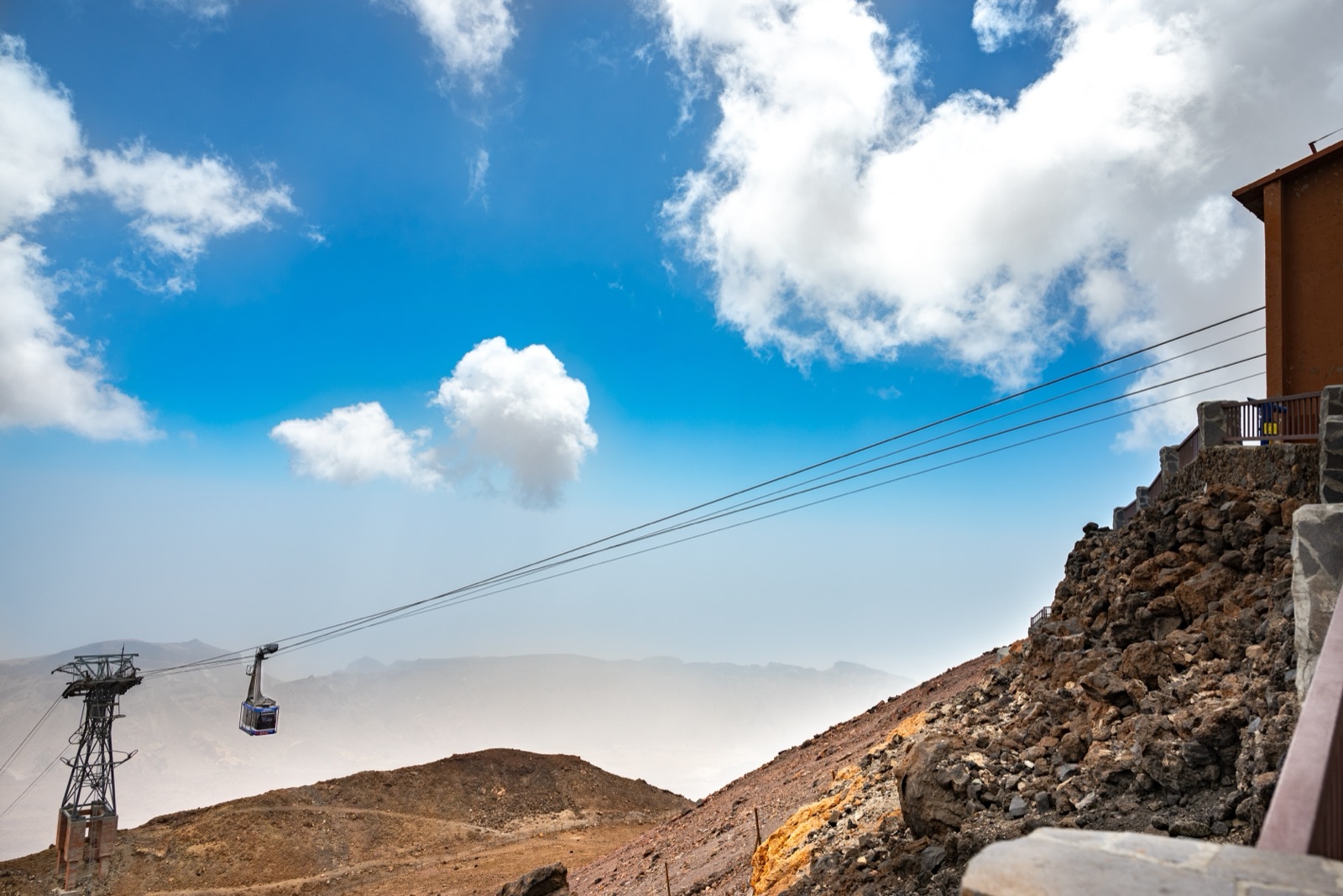 A cabin heading up toward La Rambleta — timed-entry tickets tie you to a specific ascent window.
Where to buy: official site vs resellers
You have two sensible options.
Buy direct from Volcano Teide (volcanoteide.com). You get the full choice of time slots, the official cancellation terms, and the cheapest headline price. Date and time changes are free up to 6:00 pm on the day before your visit, which is genuinely useful on a mountain where weather closures are routine.
Buy through a reseller such as GetYourGuide. Prices are typically the same or a couple of euros more, but cancellation windows are often more generous, and bundled products — cable car plus summit permit, transport from the resorts, sunset tours — are easier to compare in one place. If the official site shows your date sold out, operators holding allocations are frequently the only way onto the mountain that week. Browse the tours and tickets we rate for current options.
What I would not do is turn up at the base station without a booking: walk-up tickets exist when capacity allows, but in practice the morning slots are gone and you will be offered mid-afternoon or nothing.
Why it sells out, and how far ahead to book
Capacity is finite, Tenerife’s demand is year-round, and the best conditions are concentrated in the first two or three hours of operation. The result is predictable:
- First cars of the morning (9:00–10:30) sell out first, often a week or more ahead in July, August, Christmas and Easter.
- Whole days sell out in peak season, particularly when a good-weather window follows a run of closures and two days’ worth of demand lands on one day.
- Sunset slots are capped at 90 people and can vanish weeks ahead in summer.
As a working rule: book as soon as your Tenerife dates are fixed, and no later than a week out in high season. If you are combining the ride with a summit permit, the permit is the scarcer resource by far — plan around that first.
Opening times in 2026
The cable car opens at 9:00 am year-round; what changes with the season is the last ascent and last descent. These are the published 2026 ranges:
| Dates (2026) | First ascent | Last ascent | Last descent |
|---|---|---|---|
| 1 Jan – 27 Mar | 9:00 | 16:00 | 16:50 |
| 28 Mar – 12 Apr (Easter) | 9:00 | 17:40 | 18:30 |
| 13 Apr – 30 Jun | 9:00 | 16:00 | 16:50 |
| 1 Jul – 30 Sep | 9:00 | 17:40 | 18:30 |
| 1 Oct – 13 Oct | 9:00 | 17:00 | 17:50 |
| 14 Oct – 24 Oct | 9:00 | 16:30 | 17:20 |
| 25 Oct – 31 Dec | 9:00 | 16:00 | 16:50 |
Base-station parking opens at 8:00 am. Check the official site close to your date — these bands shift slightly year to year with Easter and daylight.
Wind closures and the refund rules
This is the part of the small print worth actually reading. La Rambleta sits on an exposed shoulder at 3,555 m, and the Teleférico shuts whenever wind at the top exceeds safe operating limits. Closures are common — snow and ice add more in winter, but strong wind days happen in every month, including July.
How it works in practice:
- Volcano Teide assesses conditions early each morning and notifies booked customers of a closure by email and text at around 8:30 am.
- If the service is suspended and the delay reaches 90 minutes or more, you are entitled to a full refund.
- Free date changes up to 6:00 pm the day before mean that if the forecast looks ugly, you can move your slot yourself rather than gambling.
Two practical consequences. First, never book the cable car for your last morning on the island — book it early in the trip so a closure is just a reshuffle. Second, check the wind forecast at altitude (not the coastal forecast) the evening before, and move your booking while changes are still free if gusts at 3,500 m look marginal.
What you can — and cannot — reach at the top without a permit
From La Rambleta, three numbered trails fan out. Two are free to walk with any cable car ticket; one is not.
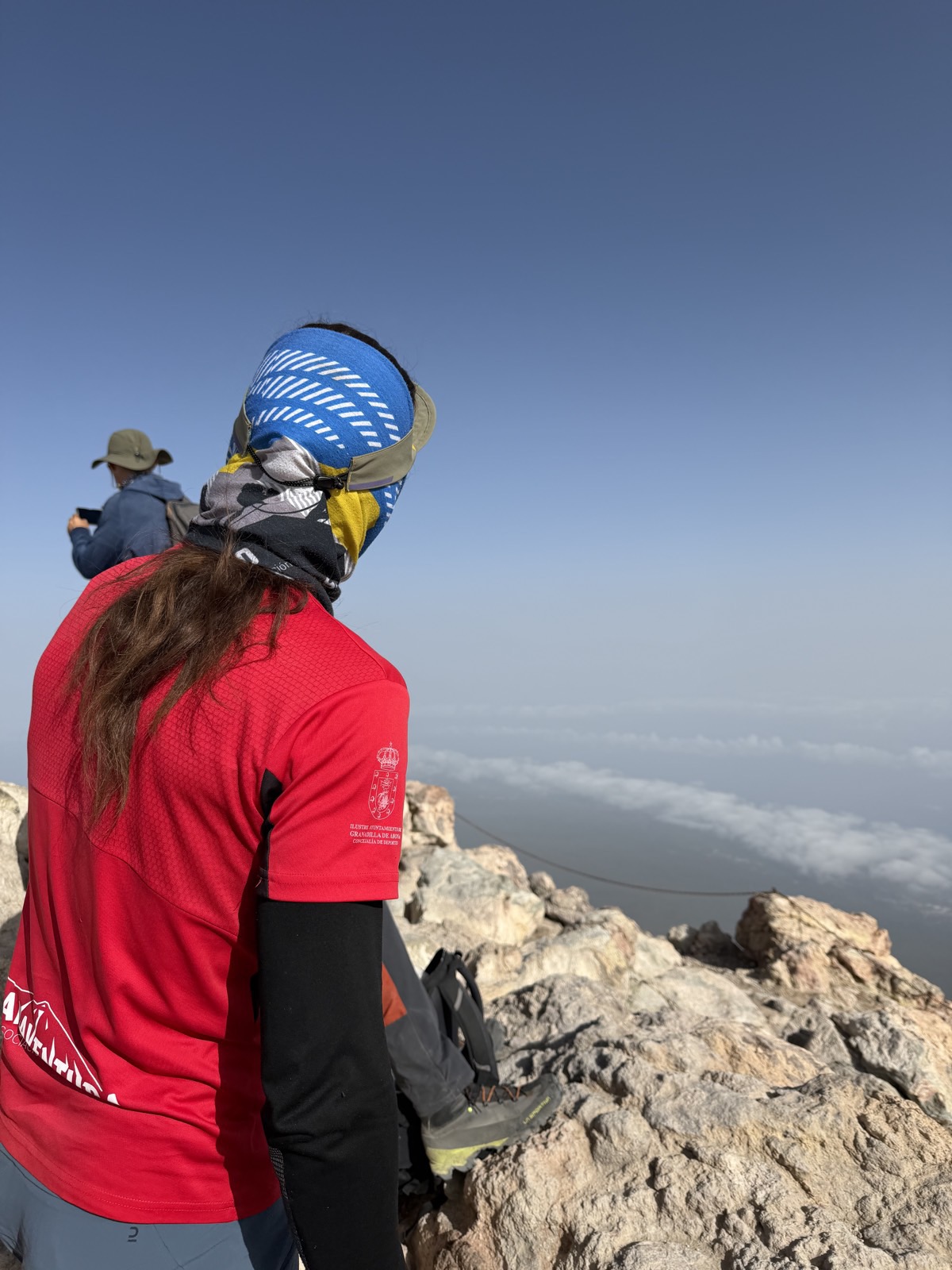 Above the cloud layer near the top station — on a normal trade-wind day the clouds sit far below you, with the caldera and the coast poking through.
Trail 12 — Mirador de Pico Viejo. A short, mostly level path south-west to a viewpoint over Pico Viejo’s crater, roughly 800 m across, with — on clear days — La Gomera, La Palma and El Hierro floating on the Atlantic beyond. No permit needed.
Trail 11 — Mirador de La Fortaleza. The northern twin: a balcony over the Orotava side, looking down on the sea of clouds that usually blankets the north coast, and across the whole 16 km sweep of the Las Cañadas caldera. No permit needed.
Trail 10 — Telesforo Bravo. The one that matters: the final zigzagging climb from La Rambleta to the crater rim at 3,715 m, with a named, dated permit checked at the trailhead. Permits are limited to around 200 people per day in two-hour slots, and since 19 January 2026 they are no longer free: booking now runs through the Cabildo’s Tenerife ON platform with a fee of €15 for non-resident adults going unguided (€10 through a licensed guide; Tenerife residents and under-14s exempt). Slots are released in weekly batches and disappear fast — the mechanics have changed more than once recently, so read our summit permit guide and verify on Tenerife ON before you plan around it. If the permit calendar is empty, guided summit tours with permits included are the standard workaround.
Allow 30–45 minutes for each viewpoint trail. They are short, but you are walking at 3,555 m, and everything at that altitude takes longer than the distance suggests. Volcano Teide asks day visitors to plan around an hour at the top; permit holders get a two-hour window.
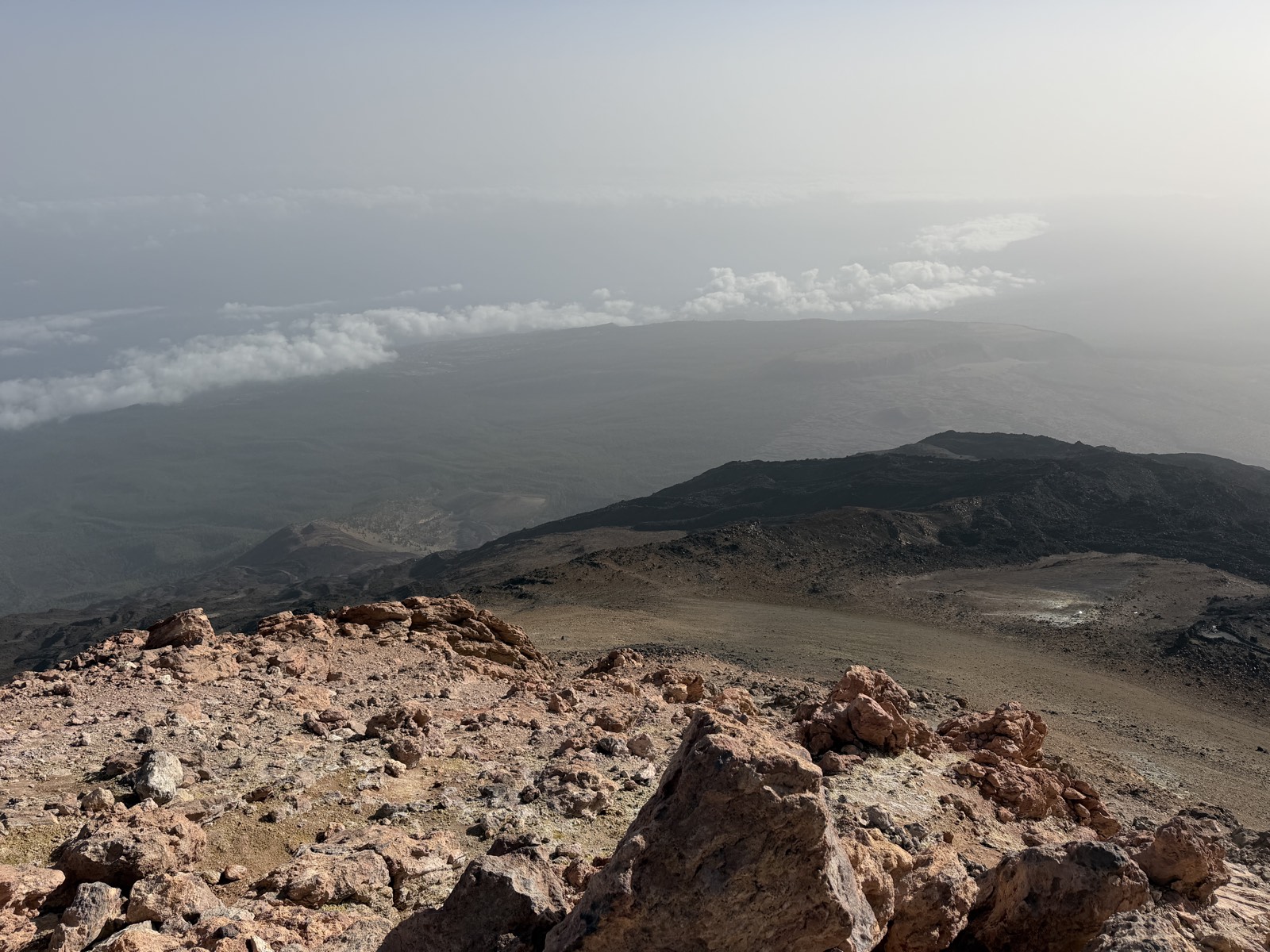
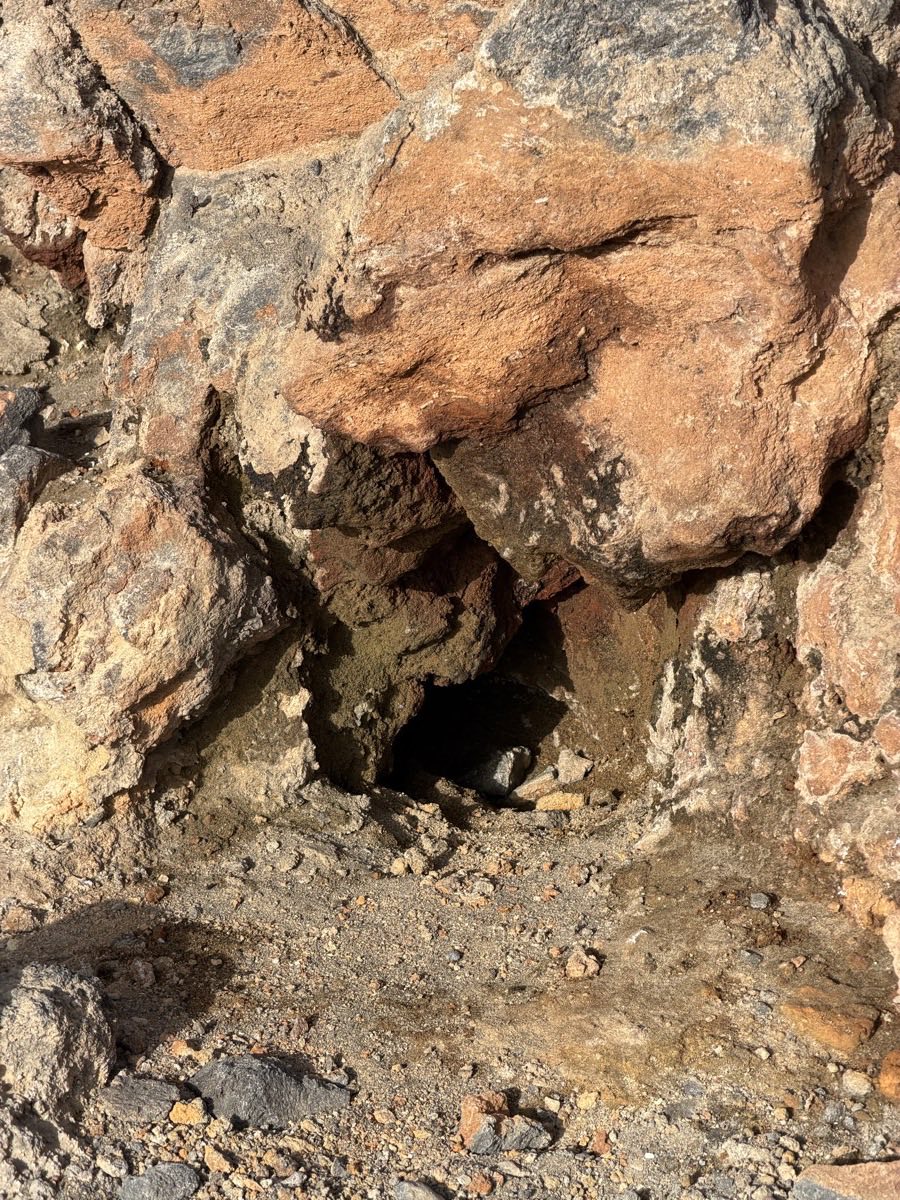 Oxidised, sulphur-tinged rock near the top of the mountain — up here the ground itself vents warmth, and you will catch the smell of sulphur on the wind near the summit fumaroles.
Altitude: what 3,555 m feels like
Stepping out of the cabin, you have gained 1,200 m of altitude in eight minutes. Air pressure at La Rambleta is roughly two-thirds of sea level, and most people feel it within minutes: a lightly pounding head, breathlessness on the smallest uphill, occasionally mild nausea or dizziness. For a fit adult it is uncomfortable rather than dangerous over a one-hour visit, but take it seriously:
- Walk slowly — treat the viewpoint trails as strolls, not hikes.
- Drink water before and during; skip the big lunch and the wine beforehand.
- If someone develops a severe headache, vomiting or confusion, take them down on the next car. Descent fixes altitude problems; nothing else does.
Who cannot ride: Volcano Teide bars pregnant women, people with heart conditions, and children under 3 from ascending, precisely because of the rapid pressure change. If you have any significant cardiovascular or respiratory condition, talk to a doctor before booking. The upper trails are rough volcanic ground and the operator also advises the ascent is unsuitable for people with reduced mobility — the base station is accessible, but La Rambleta’s paths are not.
Getting there and parking
The base station is on the TF-21 at about km 43, signposted “Teleférico”. Driving takes roughly an hour from Costa Adeje (TF-21 via Vilaflor), a little over an hour from Puerto de la Cruz (TF-21 through La Orotava), and around 90 minutes from Santa Cruz via the TF-24 ridge road. Station parking is free and opens at 8:00 am — it fills by mid-morning in peak season; arriving 30–40 minutes before your slot is about right.
By bus, two Titsa lines reach the park daily, one departure per day each way: the 342 from Costa Adeje bus station (09:25, via Los Cristianos and Vilaflor) and the 348 from Puerto de la Cruz (09:30, via La Orotava). Both stop at the cable car, and both start back mid-afternoon — the 348 leaves the Parador at 16:00, the 342 starts back from El Portillo at 15:15 and passes the Teleférico stop at around 15:25. That gives you roughly a four-hour window on the mountain, workable for a cable car visit but tight; check the current timetables on titsa.com before relying on them. Full route-by-route detail, including driving each road, is in our getting to Teide guide.
Best time slots: go early
Tenerife’s standard pattern is clear mountain mornings with haze building from late morning. The first cars at 9:00–10:00 reliably get the sharpest visibility, the calmest wind and the emptiest viewpoint trails; by early afternoon the light flattens and the queues at both stations peak. For the classic sea-of-clouds views, it is the first cars or the sunset service — nothing in between compares. More on seasonal patterns in our guide to the best time to visit Teide.
 The sea of clouds over the coast, photographed from the upper mountain shortly after sunrise — this is what the first cars of the morning get.
What to wear (yes, even in July)
The most common mistake at the base station is shorts and a t-shirt. Expect the top to be 10–15°C colder than the coast, before wind chill — at dawn in July I was within a couple of degrees of freezing in the wind, and even at midday in August La Rambleta rarely feels warm. Bring:
- A proper windproof layer plus a warm mid-layer, year-round
- Trainers with grip at minimum — the viewpoint trails are loose volcanic gravel
- Sunglasses and high-factor sunscreen: UV at 3,555 m is fierce and there is zero shade
- Hat and gloves from October to May, and water whatever the month
In winter, snow and ice can close the upper trails even when the cable car itself runs — check conditions on the day.
Frequently asked questions
Do I need to book the Teide cable car in advance?
Yes, in all but the quietest weeks. Tickets are sold for timed slots and the morning cars routinely sell out days ahead — more than a week in July, August, Christmas and Easter. Book once your dates are fixed, via the official site or a reseller with free cancellation; walk-up buyers are usually left with poor afternoon slots or nothing.
Does the cable car go to the top of Mount Teide?
No. It ends at La Rambleta, 3,555 m — about 160 vertical metres below the summit. The final climb to the 3,715 m crater is the Telesforo Bravo trail (no. 10), which needs a separate, limited permit booked through Tenerife ON, fee-charged since January 2026. Without one you can still walk two free viewpoint trails at the top. See our summit permit guide for the booking mechanics.
What happens if the cable car closes for wind on my day?
Volcano Teide notifies booked customers by email and SMS at around 8:30 am on closure days. If the suspension lasts 90 minutes or more you get a full refund, and you can also move your booking free of charge up to 6:00 pm the day before. The sensible play is to book the cable car early in your holiday so a closure costs you nothing but a reshuffle.
How long does a cable car visit take?
Budget two and a half to three hours door to door at the mountain: arrive 30–40 minutes before your slot, eight minutes up, about an hour at the top (enough for one viewpoint trail, done slowly), then the queue and ride down. Add another hour or so each way for driving from the coast, and a full two-hour slot at the top if you hold a summit permit.
Can I ride up and walk down instead?
Yes — single-leg tickets exist precisely for this. A one-way descent (€23.50 non-resident adult) suits people who climbed up on foot overnight; a one-way ascent lets you ride up and walk down via Montaña Blanca (trail 7), a 1,200 m descent on loose pumice that is harder on the knees than it sounds. Note the walk down from the summit itself still requires the trail 10 permit; descending from La Rambleta does not.
Is the cable car suitable for children and pregnant women?
Children under 3 are not allowed to ascend at all, and Volcano Teide also bars pregnant women and people with heart conditions — the eight-minute, 1,200 m altitude gain is a genuine physiological jolt. Children aged 3–13 pay the child fare and generally cope well if you keep the pace slow and the water flowing. The sunset service has a stricter minimum age of 8.
Is the cable car worth it if I can’t get a summit permit?
Honestly, yes. The two free viewpoint trails at La Rambleta — Pico Viejo’s 800 m-wide crater on trail 12 and the Fortaleza balcony over the sea of clouds on trail 11 — deliver most of the visual drama, including the neighbouring islands on clear days. The summit adds the crater, the sulphur smell and the highest-point bragging rights, but a permit-less visit is nobody’s consolation prize.
How much does the Teide cable car cost in 2026?
The standard non-resident return is €42 for adults and €21 for children aged 3–13, with single ascent or descent legs at €23.50/€11.75. Bundles run from €45.50 (audio guide) to €54.50 (guided Pico Viejo viewpoint walk), and sunset departures start around €72. Canary Islands residents pay sharply reduced fares. Prices vary slightly by date on the booking calendar, so confirm the live figure on the official site before you buy.