Getting to Mount Teide: By Car, Bus or Tour
There is no town inside Teide National Park, no railway up the mountain and no airport shuttle: you arrive by one of four mountain roads, on one of two once-a-day public buses, or in a tour coach. The bus locks you into four hours or so in the park; a car lets you be at the Montaña Blanca trailhead at 3am, which is how I did my July 2026 summit climb. Here is every approach in detail, plus the parking realities and the winter closures nobody mentions until they’re stuck at a barrier.
The four roads into the park
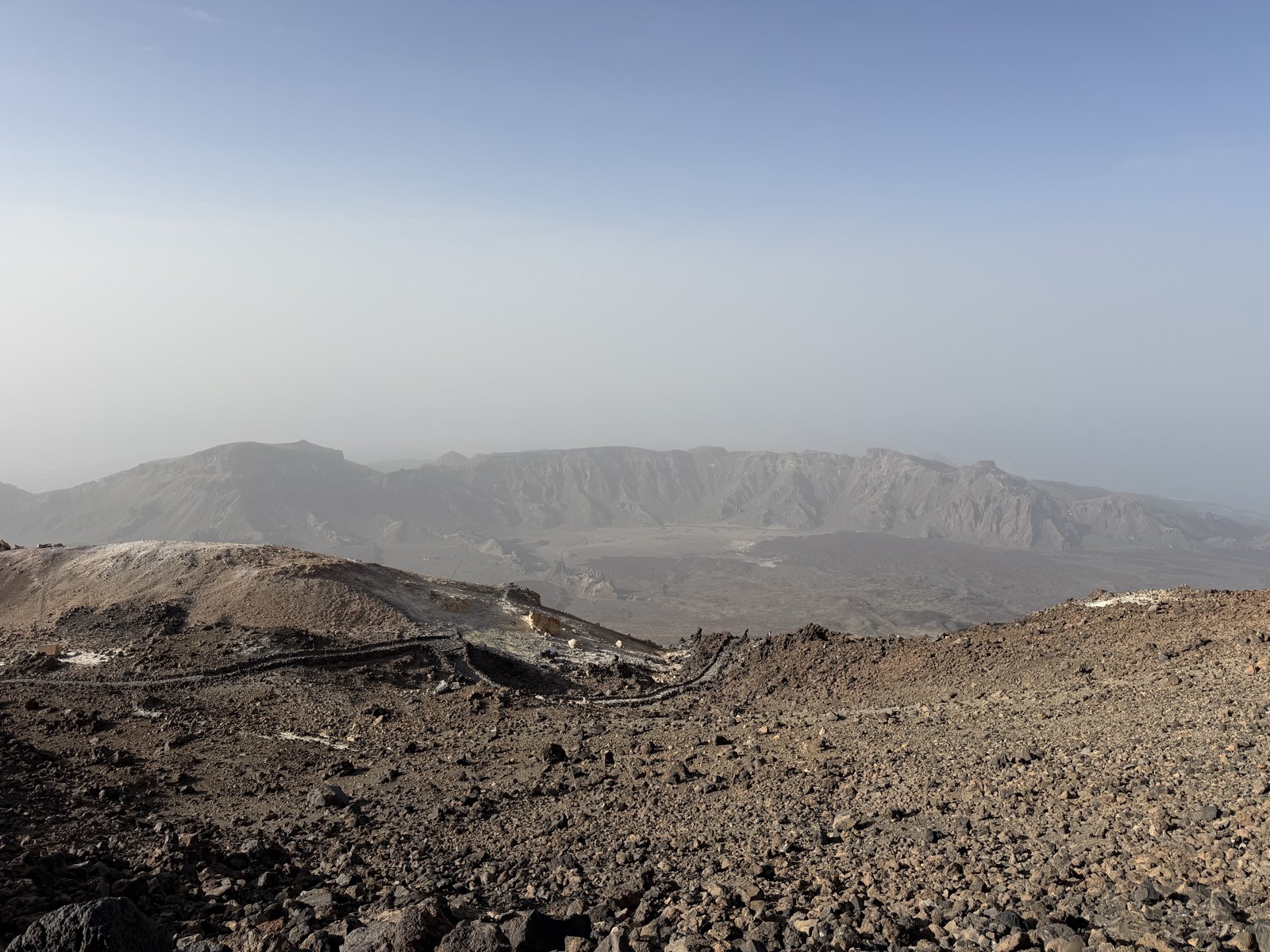
Every route to Teide funnels into one of two entrances: El Portillo in the north-east corner of the caldera (TF-21 from La Orotava, TF-24 from La Laguna) or Boca Tauce in the south-west (TF-21 from Vilaflor, TF-38 from Chío). From either entrance it’s a 10–20 minute run across the caldera floor to the cable car base station at 2,356 m on the TF-21.
| Road | Climbs from | Enters the park at | Best if you’re staying in | Character |
|---|---|---|---|---|
| TF-21 (north) | La Orotava (~350 m) | El Portillo | Puerto de la Cruz, north coast | Steady hairpins through pine forest and the cloud band |
| TF-21 (south) | Vilaflor (~1,400 m) | Boca Tauce | Costa Adeje, Los Cristianos | The classic switchback climb; tightest bends of the four |
| TF-24 (east) | La Laguna / La Esperanza | El Portillo | Santa Cruz, La Laguna, north-east | Long ridge road, sea-of-clouds views on both sides |
| TF-38 (west) | Chío, near Guía de Isora | Boca Tauce | Los Gigantes, Puerto Santiago, Callao Salvaje | Smoothest gradients, quietest traffic, lava-field scenery |
TF-21 from La Orotava (the north approach)
The busiest approach, and the one both public buses use for part of their route. You leave La Orotava’s old town, climb through Aguamansa, then wind up through Canarian pine forest. Somewhere between about 1,000 m and 1,500 m you’ll usually punch through the trade-wind cloud layer — visibility drops to thirty metres in the fog band, then you burst out into hard sunshine above a white ocean of cloud. Don’t let a grey morning in Puerto de la Cruz cancel your plans; it’s usually clear above 1,500 m. The road tops out at El Portillo (roughly 2,050 m), where the visitor centre marks the park boundary.
TF-21 from Vilaflor (the south approach)
From the southern resorts you climb through Arona and La Escalona to Vilaflor — at around 1,400 m one of the highest villages in Spain — then tackle the famous wall of switchbacks above the village. The bends are tight and relentless for about ten minutes; it’s the most demanding stretch of the four, though the tarmac is good and the traffic patient. Then you crest the pass, the pines stop dead, and the caldera opens out at Boca Tauce, with the Roques de García and the Parador a few minutes on.
TF-24 from La Laguna (the east approach)
The Carretera de La Esperanza is the connoisseur’s route: a long ridge-top road from La Laguna that rides the spine of the island, with the north-coast cloud sea on your right and, on clear days, the south coast on your left. It passes the Izaña junction for the Teide Observatory area at about 2,390 m before dropping to meet the TF-21 at El Portillo. Direct if you’re based in Santa Cruz or La Laguna, and the viewpoints — Mirador de Ortuño, La Tarta’s layered tephra cutting — are worth building stops around.
TF-38 from Chío (the west approach)
The quiet one. From Chío, above Los Gigantes, the TF-38 climbs on gentler gradients than either TF-21 section, through pines and then across the raw lava fields of the 1798 Narices del Teide eruption — the last inside what is now the park. The Mirador de Chío makes a good leg-stretch. If you’re on the west coast, or simply dislike hairpins, this is the road up, entering at Boca Tauce.
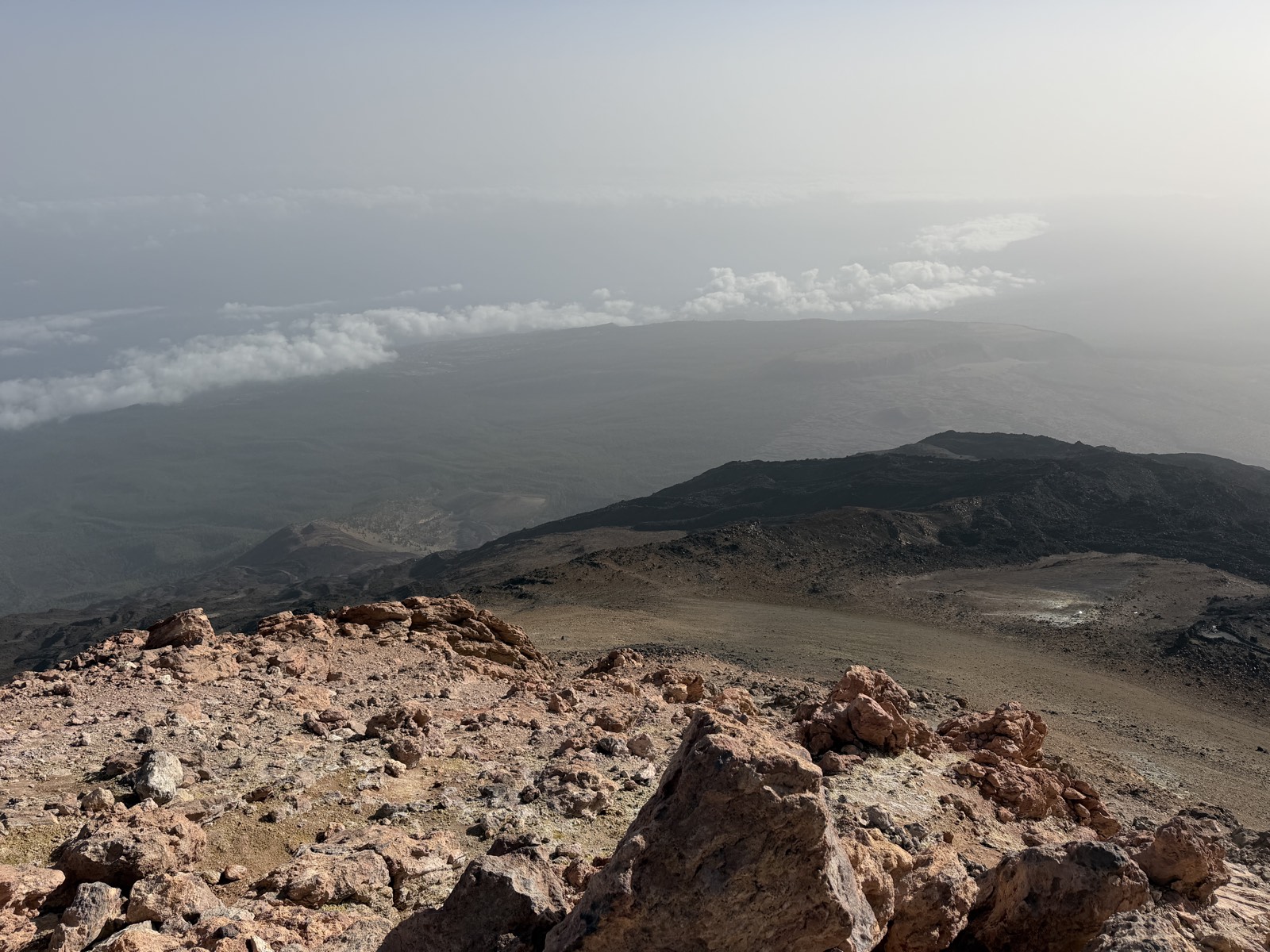 The trade-wind cloud layer from above. On the north-side roads you drive up through this band — thick fog in the pines, then clear sky.
Driving times from the main resorts
Typical times to the cable car base station in normal traffic, without stops. Add 30–60 minutes in practice, because you will stop — the viewpoints are half the point of driving yourself.
| From | Route | Approximate time |
|---|---|---|
| Costa Adeje / Los Cristianos | TF-28/TF-51 to Vilaflor, then TF-21 | 1 h 10 – 1 h 20 |
| Costa Adeje (avoiding switchbacks) | TF-82 to Chío, then TF-38 | 1 h 15 – 1 h 30 |
| Los Gigantes / Puerto Santiago | TF-38 via Chío | about 1 h |
| Puerto de la Cruz | TF-21 via La Orotava | about 1 h |
| Santa Cruz / La Laguna | TF-24 via La Esperanza | 1 h 15 – 1 h 30 |
Two things worth knowing before you set off. First, altitude: you’re going from sea level to 2,356 m in about an hour, and to 3,555 m if you ride the cable car straight up — take it gently for the first half hour at the top. Second, brakes: on the way down engage a low gear rather than riding the pedal. The smell of cooked brakes at the Vilaflor hairpins is a Tenerife hire-car classic.
By public bus: Titsa lines 342 and 348
Two Titsa lines reach the park — and each runs once per day in each direction. That single fact shapes the whole experience.
| Line | Route | Departs (towards Teide) | Leaves the park | Journey time |
|---|---|---|---|---|
| 342 | Costa Adeje station → Los Cristianos → Vilaflor → Boca Tauce → Parador → cable car → El Portillo | 09:25 daily | 15:15 from El Portillo, ~15:25 from the cable car, ~15:40 from the Parador | ~2 h up |
| 348 | Puerto de la Cruz station → La Orotava → Aguamansa → El Portillo → cable car → Parador | 09:30 daily | 16:00 from the Parador, ~16:05 from the cable car, ~16:20 from El Portillo | ~1 h 40 up |
Both serve the stops that matter — El Portillo visitor centre, the cable car base station and the Parador (for Roques de García). Timetables get tweaked; confirm the exact minutes for your stop on titsa.com a day or two before.
The hard truth: with an arrival between about 11:00 and 11:30 and a departure between 15:15 and about 16:20 depending on line and stop, the bus gives you roughly four to five hours inside the park. That’s enough for the cable car up and down plus a short walk at La Rambleta — if you’ve pre-booked a slot — or for the Roques de García loop and lunch at the Parador. Not both. It also rules out sunrise, sunset and any serious hike, and if you miss the return you’re negotiating with strangers in the car park.
On fares: the Teide lines sit outside the Canary Islands’ subsidised-travel scheme, and recent traveller reports consistently say the tenmás card and its free-travel discounts are not accepted on the 342 and 348 — budget for a paid single each way and check the fare calculator on titsa.com for the current figure.
There’s also a short intra-park shuttle, line 341, currently a single midday rotation between the Parador, the cable car, the Montaña Blanca trailhead and El Portillo. It lets bus visitors reposition once — cable car first, then Roques de García — but treat it as a bonus, not a plan.
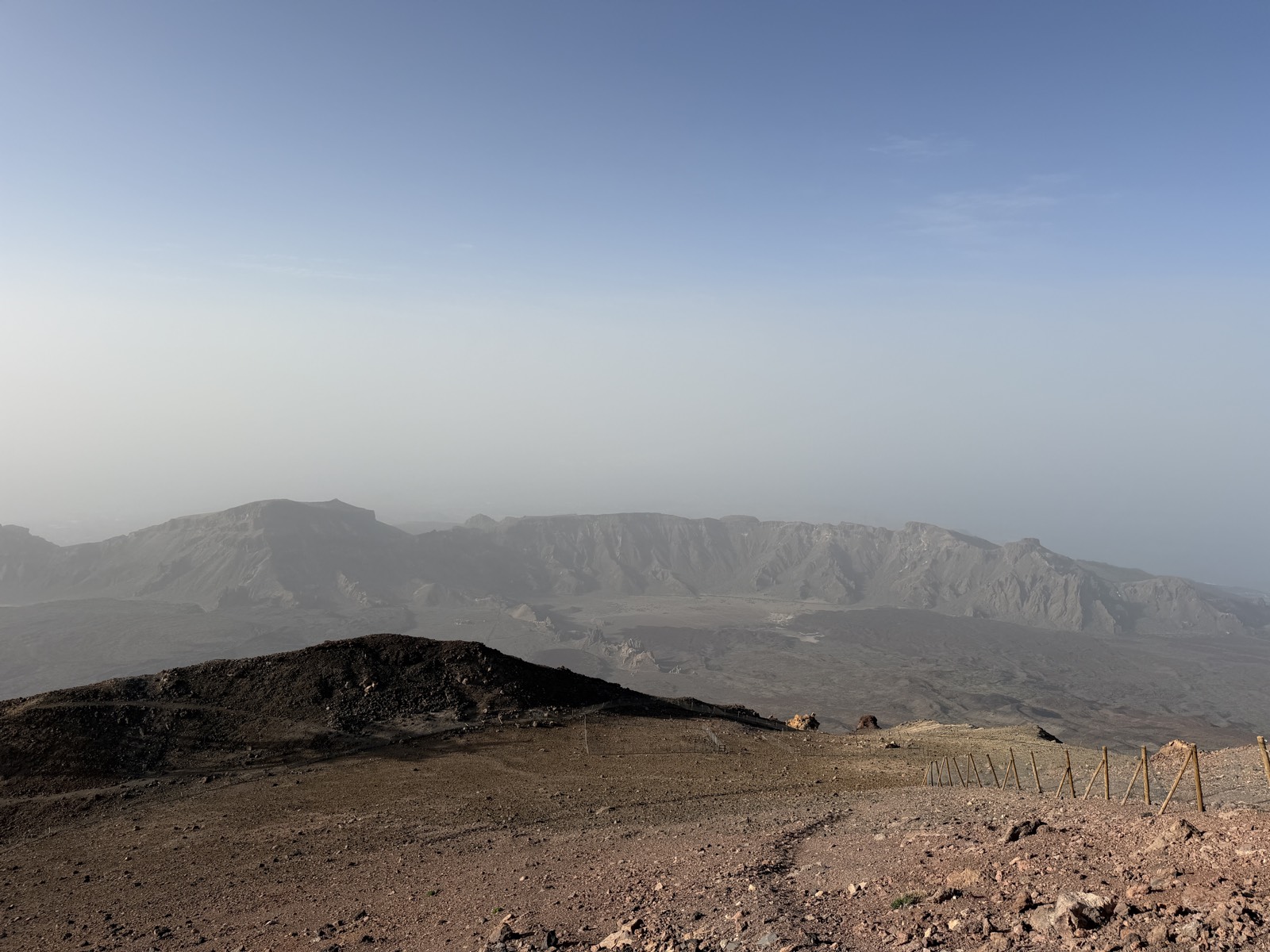 Las Cañadas from the road: the caldera is roughly 16 km across, and the drive from El Portillo to Boca Tauce takes a good 20 minutes.
Parking inside the park
National park entry is free and, as of mid-2026, so is all the parking — but the lots are small and the park draws over five million visitors a year — a record 5.2 million in 2024. After mid-morning the maths is against you.
- Cable car base station (TF-21, 2,356 m): free, but only a couple of hundred spaces. In summer it’s effectively full from about 09:30–10:00. If your cable car ticket is booked for a morning slot, arrive 30–40 minutes early for the parking alone.
- Montaña Blanca trailhead (TF-21 km 40.2): a small lay-by, nothing more. When I pulled in before 3am for the night ascent there were already a dozen cars; on busy days it overflows down the road by dawn. Plan an early start for the parking as much as the heat — details in our hiking guide.
- Roques de García / La Ruleta (opposite the Parador): the biggest and most contested car park in the caldera, since every coach tour stops here. Before 10:00 or after 16:00 it’s easy; in the middle of the day it’s a scrum.
- El Portillo visitor centre: usually the easiest place to park, and a sensible first stop anyway for the exhibition and current trail information.
This is where the rules are actively changing: the Cabildo has announced pre-booked parking quotas (around 500 reservable spaces, residents prioritised) and access controls at the park entrances targeted at late 2026, with a shuttle-bus network from the main resorts pencilled in for 2027. None of it was in force in July 2026, but check the official Tenerife ON platform before assuming you can just drive in and park.
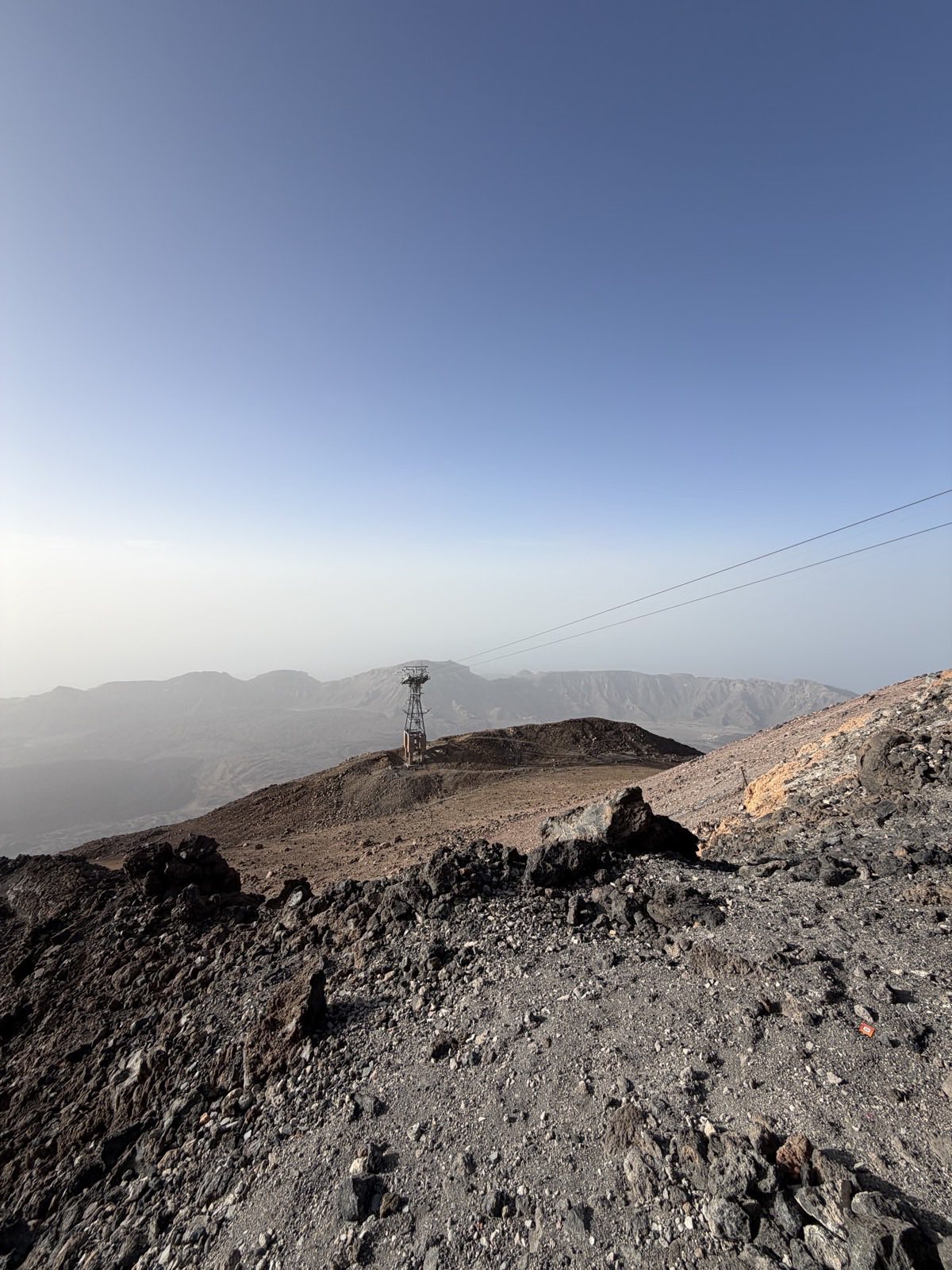 The cable car line from below the base station. The car park here fills by mid-morning in high season — book an early slot and beat the coaches.
Fuel, EVs and taxis
There is no petrol station inside the national park, and none for a long way below the boundary on any approach. Fill up at the coast or in the last big towns — La Orotava on the north side, the La Laguna/La Esperanza area on the TF-24 — and set off with at least half a tank: climbing at altitude burns noticeably more fuel than motorway miles.
Electric hire cars handle Teide well — the range estimate plummets on the way up, then regenerative braking claws a chunk back on the descent. Don’t count on charging inside the park: arrive with comfortably more than half charge.
Taxis will take you up, but it’s an expensive one-way bet: metered fares over a 50-plus-kilometre mountain run, and no rank at the cable car for the return. If you must, agree a price and pick-up time in advance. For the money, a guided day trip almost always makes more sense.
When a tour beats driving yourself
I’m biased towards independence — the freedom to leave Costa Adeje at 2am for a sunrise summit is why you rent the car. But there are honest cases where a coach day tour from the tours listing is simply the better call:
- You’d rather look than drive. The driver of a hire car sees about ten per cent of the scenery. On a coach you get the views without white-knuckling the Vilaflor bends.
- You want the summit. Guided ascents bundle the cable car with the trail 10 access slot — the paid, quota-limited reservation independent visitors often find booked out. Our summit permit guide explains the system.
- Sunrise or stars. The buses can’t do it and night mountain driving isn’t for everyone; organised sunrise and sunset trips handle the antisocial hours.
- Winter uncertainty. Operators track road closures; if the park’s shut they cancel or reroute, and you’re not the one stuck at a barrier.
- The parking maths. A tour’s timing problem is the operator’s problem. Your hire car’s parking problem, at 11am in August, is very much yours.
A standard day tour covers Vilaflor or the La Esperanza ridge on the way up, the Roques de García, the cable car (check whether the ticket is included or extra) and a viewpoint on the way down — book via GetYourGuide or the official Volcano Teide site and read the inclusions carefully.
Winter access: snow, ice and closures
It genuinely snows on Teide most winters, sometimes heavily, and the island’s response is to shut the mountain roads — first to clear them, then to manage the crowds who drive up to see the snow. Closures typically hit the TF-21 above Aguamansa and above Boca Tauce, and the TF-24 from the Los Loros junction; the stretch between El Portillo and the cable car is usually first to close and last to reopen. Ice can close roads overnight even without fresh snow.
In recent winters the Cabildo has also run a formal “snow operation” on busy weekends: private cars restricted from Friday evening to Monday morning, a 50 km/h limit in the park, and free shuttle buses from Vilaflor, La Esperanza and Aguamansa, ascents roughly 10:00–14:00 with returns to 17:00. If snow is forecast during your trip, assume some version of this will be running.
Where to check, in order of usefulness:
- @carreterasTF on X (Twitter) — the Cabildo’s roads account posts closures and reopenings in near-real time (in Spanish).
- The Cabildo’s road information pages at tenerife.es/carreteras, or its road information line on 900 210 131.
- The cable car’s own status page on volcanoteide.com — high wind shuts the cable car far more often than snow shuts the roads; no point beating the closure to find the cabins parked.
Snow chains are required when the Guardia Civil says they are — signs and officers at the control points make it unambiguous. Almost no hire car comes with them, so during an active snow episode you’re realistically not driving up; take the shuttle or wait a day. The flip side: a post-snowfall day with reopened roads is one of the most spectacular sights in Spain — white slopes over black lava down to a blue Atlantic. More on seasons in our guide to the best time to visit.
The 2026 rule changes in one paragraph
Access to Teide is mid-reform, so date-stamp anything you read. Since 19 January 2026 the two summit-area trails — no. 7 (Montaña Blanca–La Rambleta) and no. 10 (Telesforo Bravo, the final climb to the crater) — need a timed reservation on the Cabildo’s Tenerife ON platform, with fees for non-residents (currently €6–10 for trail 7 depending on the day, €15 for trail 10; under-14s free; slots released Mondays at 07:00 Canary time, and since March 2026 the calendar runs 56 days ahead). The park itself — roads, viewpoints, Roques de García, visitor centres — remains free with no reservation. Announced but not yet in force as of July 2026: parking reservations, entry-point access controls and the 2027 shuttle network. Check tenerifeon.es before you travel.
Frequently asked questions
Can you get to Mount Teide without a car?
Yes — the once-daily Titsa buses (342 from Costa Adeje at 09:25, 348 from Puerto de la Cruz at 09:30), a guided coach tour, or a taxi. The buses are cheap but allow only about four to five hours in the park. For most visitors without a car a day tour is the practical answer: it solves transport, timing and, with cable car or summit access included, the booking hurdles too.
How long does it take to drive from Costa Adeje to Mount Teide?
Allow 1 hour 10 minutes to 1 hour 20 minutes to the cable car base station via Vilaflor on the TF-21, without stops. The route via Chío and the TF-38 takes slightly longer but avoids the tight switchbacks. In practice budget closer to two hours — the viewpoints deserve stops — and add contingency in winter, when ice can close the top sections at short notice.
Is the road up Mount Teide scary to drive?
It’s a proper mountain road but well engineered: two lanes, good tarmac, barriers on the exposed bends. The hardest stretch is the switchback section above Vilaflor on the southern TF-21; if hairpins worry you, take the gentler TF-38 from Chío. The real hazards are fog in the north-side cloud band, cyclists on blind bends, and overheated brakes on the descent — use a low gear going down.
Is there an entrance fee for Teide National Park in 2026?
No — driving in, parking (for now) and walking most trails, including the Roques de García loop, are free. Since January 2026 the two summit-area trails — no. 7 (Montaña Blanca–La Rambleta) and no. 10 (Telesforo Bravo) — need a paid, timed reservation on Tenerife ON for non-residents: €6–15 per adult depending on trail and day. Parking reservations and entry-point access controls have been announced but weren’t in force as of July 2026.
Do I need snow chains to drive to Teide in winter?
Only when conditions demand them, enforced by the Guardia Civil at control points on the access roads. Hire cars almost never come with chains, so an active snow episode effectively means you can’t drive up — the roads are usually closed outright anyway, and the Cabildo has run free weekend shuttles from Vilaflor, La Esperanza and Aguamansa instead. Check @carreterasTF on X for live status between December and March.
What time should I arrive to park at the cable car?
Before 09:30 in high season, earlier in August. The base-station car park is free but holds only a couple of hundred cars; once the coaches and late-morning crowd arrive you’ll be circling or on the verge. The clean play is booking the first cable car slot and arriving 30–40 minutes ahead. Or come after 16:00, when the lot empties — check last-ascent times on volcanoteide.com first.
Can I use the tenmás card on the Teide buses?
Reports from travellers and local guides consistently say no — lines 342 and 348 are treated as special tourist services outside the standard fare and free-travel schemes, so everyone pays a distance-based single fare. Use the fare calculator on titsa.com for the current price rather than relying on blog figures. Carry a bank card; drivers accept contactless on most Titsa services.
Which is the most scenic road up to Teide?
They’re all good, but the TF-24 from La Laguna is the most consistently spectacular: a ridge road with the sea of clouds below you to the north and long views south, passing the Izaña observatory turn-off. The TF-38 from Chío wins for volcanic drama, crossing the 1798 Narices del Teide lava flows. If you have a full day, drive up one northern road and down a southern one.