Best Time to Visit Teide: Month by Month, Weather and Crowds
There is no bad month to visit Teide — but there are wildly different ones. In February you can stand in snow at 3,555 m while people swim off Playa de las Américas an hour down the road; in August the coast bakes at 30°C while dawn on the summit sits in single digits. I climbed to the crater in July 2026, setting off in the dark, and even in peak summer I was glad of a down jacket at 3,400 m. This guide breaks down the park’s weather month by month, when snow closes the roads, what calima dust does to your views, and — just as important in 2026 — when the summit permits and cable car tickets actually sell out.
Two climates on one island
Teide National Park sits between roughly 2,000 and 3,715 m, on a high-altitude volcanic plateau above the trade-wind cloud layer. Temperature falls by roughly 6–7°C for every 1,000 m you climb, so the park is routinely 6–14°C colder than the coastal resorts — the gap is biggest in winter — and the summit colder still. Add wind chill on an exposed 3,700 m peak and the gap between “beach morning” and “crater rim” can be 25°C.
This is the single most common mistake visitors make. Every day of the year, people step off a coach at the cable car base station (2,356 m) in shorts and a vest top, ride up to La Rambleta at 3,555 m, and last about ten minutes in the thin, dry, windy air. Whatever month you come, bring a proper warm layer, a windproof shell, sunglasses and high-factor sun cream — the UV at altitude is fierce even when the air is cold.
The park has its own micro-seasons too. The high plateau is a mountain desert: most of its modest precipitation falls between November and March, often as snow above 2,500 m, with almost nothing from June to September. AEMET’s Izaña observatory, at 2,369 m on the park’s edge — almost exactly cable-car-base altitude — has recorded weather since 1916, and its climate normals are the best guide to what you’ll actually feel.
Month by month: what to expect
The temperatures below are the 1981–2010 climate normals from the Izaña observatory (2,369 m) — a very close proxy for the cable car base station and the Las Cañadas plateau where you’ll spend most of your visit. For the summit itself, subtract roughly 8–9°C, then subtract more for wind.
| Month | Typical daytime high at ~2,350 m | Typical overnight low | Snow days (avg) | Crowds & booking pressure |
|---|---|---|---|---|
| January | 7.5°C | 1.1°C | 2.4 | New Year spike, then quiet; islanders flood up after snowfall |
| February | 8.0°C | 1.3°C | 2.5 | Quiet apart from half-term; best snow odds |
| March | 10.2°C | 2.7°C | 2.1 | Building towards Easter |
| April | 11.8°C | 3.5°C | 0.6 | Easter is a major peak — book everything early |
| May | 14.5°C | 5.8°C | 0.2 | Shoulder-season sweet spot |
| June | 18.9°C | 9.9°C | 0 | Warm, stable, pre-peak |
| July | 23.0°C | 14.0°C | 0 | High season; calima risk; hot afternoons at 2,350 m |
| August | 22.6°C | 13.8°C | 0 | Busiest month of the year |
| September | 18.6°C | 10.4°C | 0 | Still warm, noticeably quieter |
| October | 14.3°C | 6.9°C | 0.2 | The other sweet spot: clear, calm, uncrowded |
| November | 11.1°C | 4.5°C | 0.6 | Quiet; first dustings of snow possible |
| December | 8.8°C | 2.4°C | 1.6 | Dead quiet until the Christmas–New Year surge |
A few things the table hides. Winter days in the caldera are frequently glorious — cloudless, windless, 10°C in strong sunshine feels warm — but the weather is far less reliable: Atlantic fronts bring the year’s rain and snow between November and March, and with them cable car closures and occasional road closures. June to September is almost bulletproof for stable weather, at the price of crowds and the odd Saharan dust event. May and October give you 80 per cent of the summer’s reliability with a fraction of the people, which is why I’d point most flexible travellers at those two months.
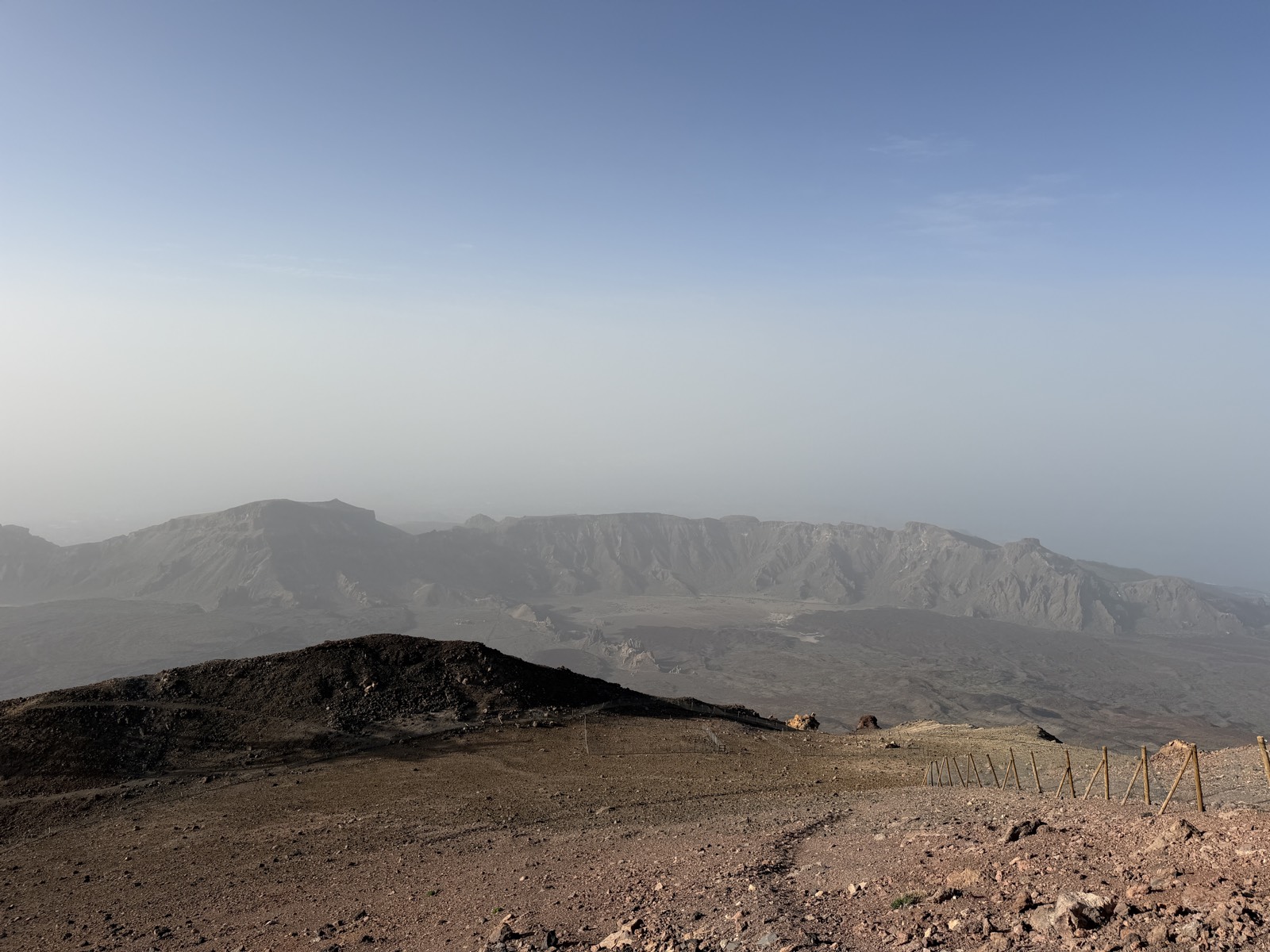 The Las Cañadas caldera, roughly 16 km across. In summer the plateau is bone dry; from December to March the same view can be white.
Snow on Teide: December to March
Yes, it snows on Tenerife — properly. Izaña averages around two snow days a month from December to February, and the summit cone above 3,000 m can hold snow for weeks after a good fall. The result is one of the strangest landscapes in Europe: a snowfield draped over orange and black volcanic desert, with the Atlantic glittering 2,000 m below. When it happens, half the island drives up to see it, which brings its own problems.
Practicalities for snow chasers:
- Roads close. The Cabildo shuts the access roads — TF-21 from La Orotava and from Vilaflor, TF-24 from La Laguna and TF-38 from Chío — whenever snow or ice makes them dangerous, controlling entry at the access points. After a big fall the roads can stay shut or filtered for days while crews clear them. Check the Cabildo de Tenerife’s road status channels on the morning you travel, and don’t rely on a hire car with summer tyres.
- The cable car stops for weather. High wind and ice shut the cable car regardless of season, and closures are most common in winter. Tickets are refundable or moveable when the operator cancels, but plan a spare day if the summit matters to you.
- The crowds are local and immediate. The weekend after a snowfall, parking at El Portillo and the Roques de García overflows by mid-morning. Go on a weekday, or go early.
- Snow does not mean deep winter kit. The classic pattern is snow underfoot, brilliant sunshine overhead. Boots, warm layers and sunglasses cover most visits; genuine mountaineering conditions apply only on the upper trails, which the park closes when iced.
For the snow-plus-desert photograph, late January and February give the best odds — but nothing is guaranteed. Some winters deliver four big falls; some barely whiten the summit.
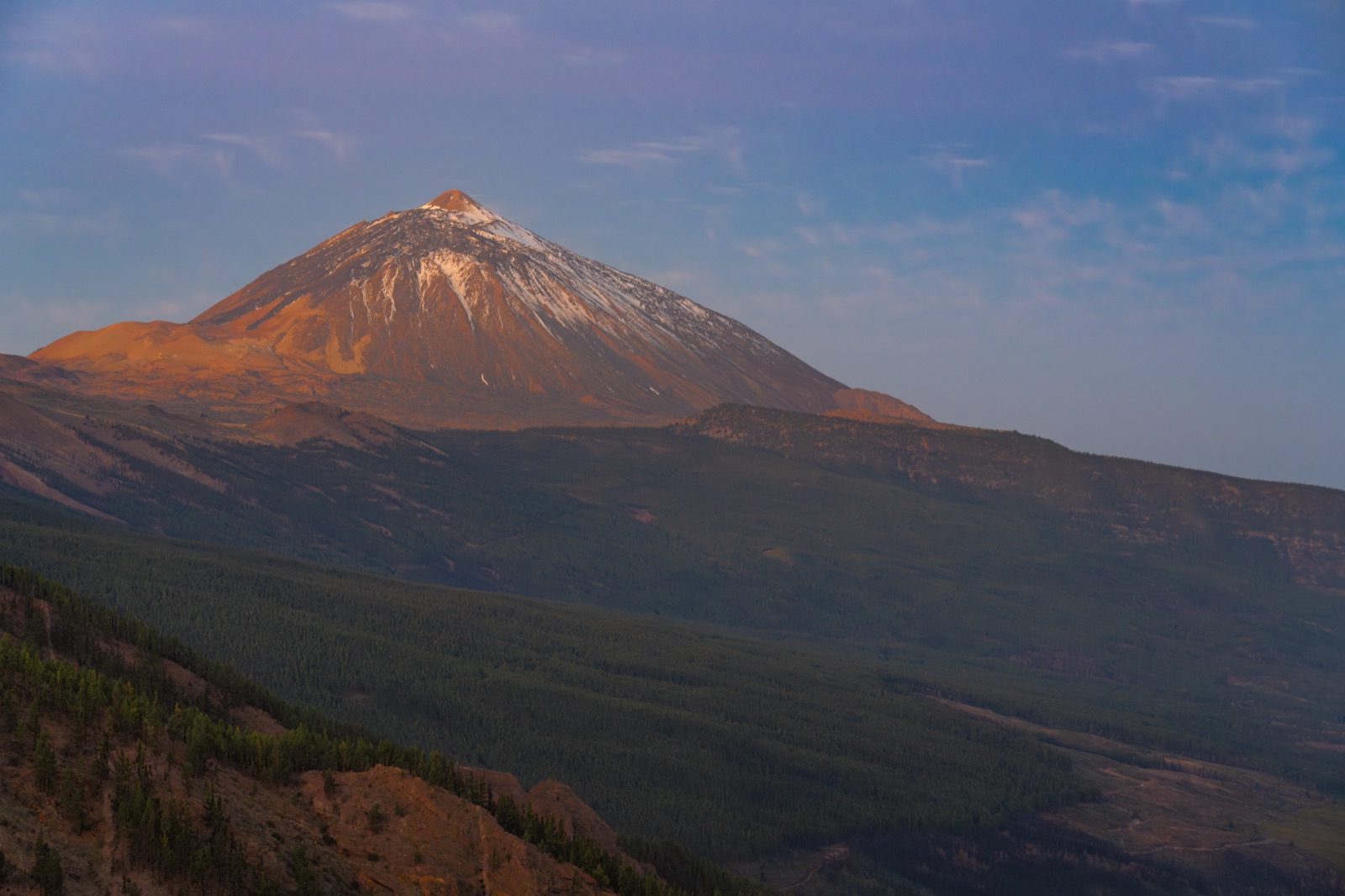 Winter alpenglow on a snow-covered Teide — the season when road and cable-car closures are most likely.
Summer: a freezing dawn above a 30°C beach
Summer is when most people visit, and on the plateau it’s honestly benign: cloudless skies for weeks, afternoon temperatures in the low twenties at 2,350 m, and the most reliable cable car operation of the year. The two things to plan around are heat lower down — the walk up Montaña Blanca (trail 7) in August afternoon sun is a slog with zero shade — and cold higher up, which nobody believes until it happens to them.
I can put numbers on that second one. I climbed in July 2026, starting up the Montaña Blanca track in the small hours to reach the crater for sunrise. At 4 a.m. at 3,200 m I was in a fleece and windproof and only just comfortable whenever we stopped; near La Rambleta, in a steady pre-dawn wind, it felt close to freezing. Dawn on the summit in high summer typically sits between about 3 and 10°C before wind chill — pleasant once the sun is up, genuinely cold at 6 a.m. Down jacket, hat, gloves: in July. The beach I’d left the previous evening was forecast 29°C.
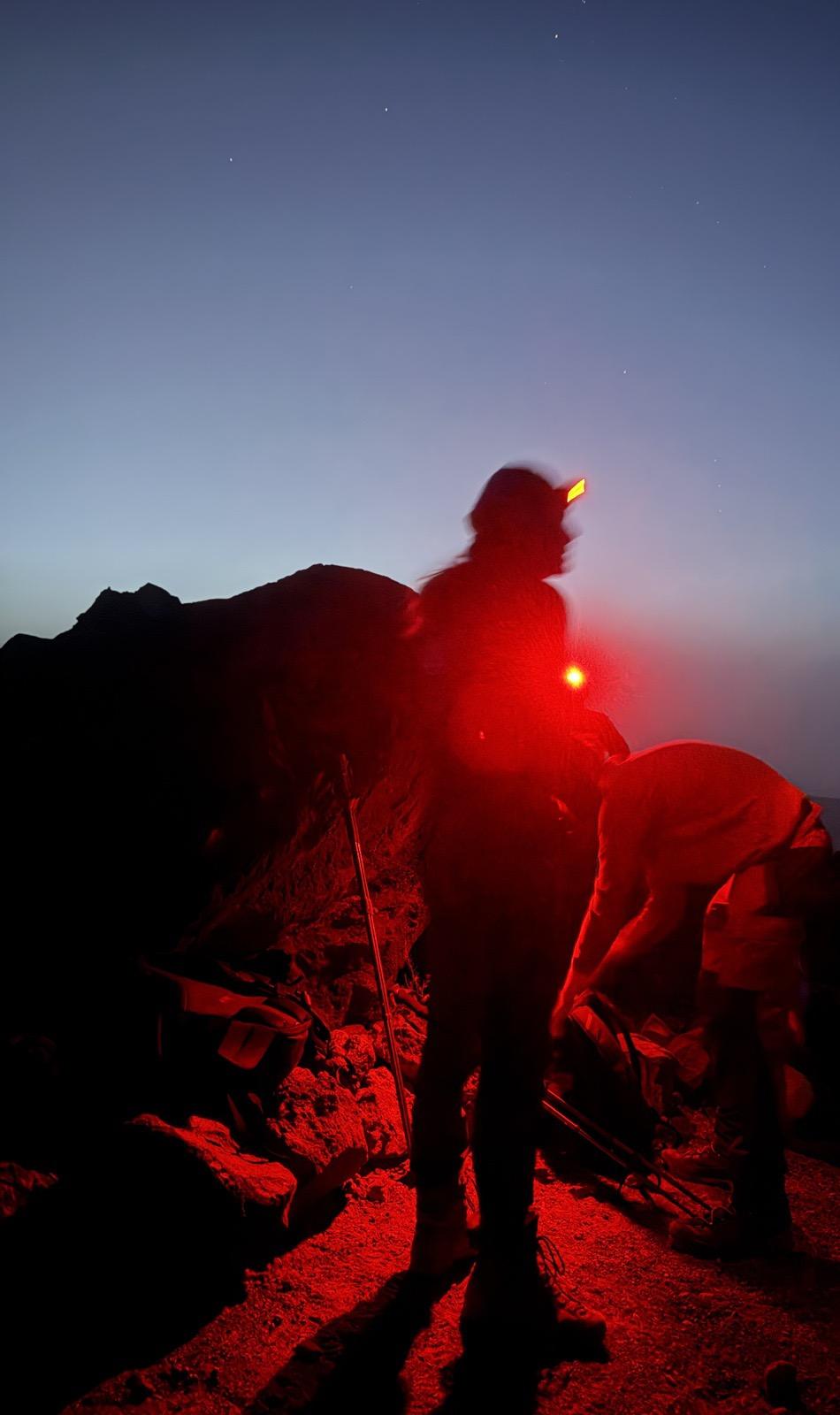 Pre-dawn on the mountain in July 2026. Headtorches, fleeces and windproofs — in the hottest month of the year.
The reward for the early start is the best atmosphere of the day: the mountain’s shadow thrown across the sea at sunrise, still air, and the trails to yourself for two hours. If you’d rather not walk through the night, the sunrise and sunset guide covers the gentler ways to get the same light, and the Altavista refuge (3,260 m) — reopened on 20 July 2026 after more than five years closed — has brought back the classic option of sleeping high and finishing the climb at dawn. It has 49 beds and prices from around €71 a night for non-residents (less for federated mountaineers and Tenerife residents); book well ahead, because demand since reopening has been intense.
Calima: when the Sahara blows in
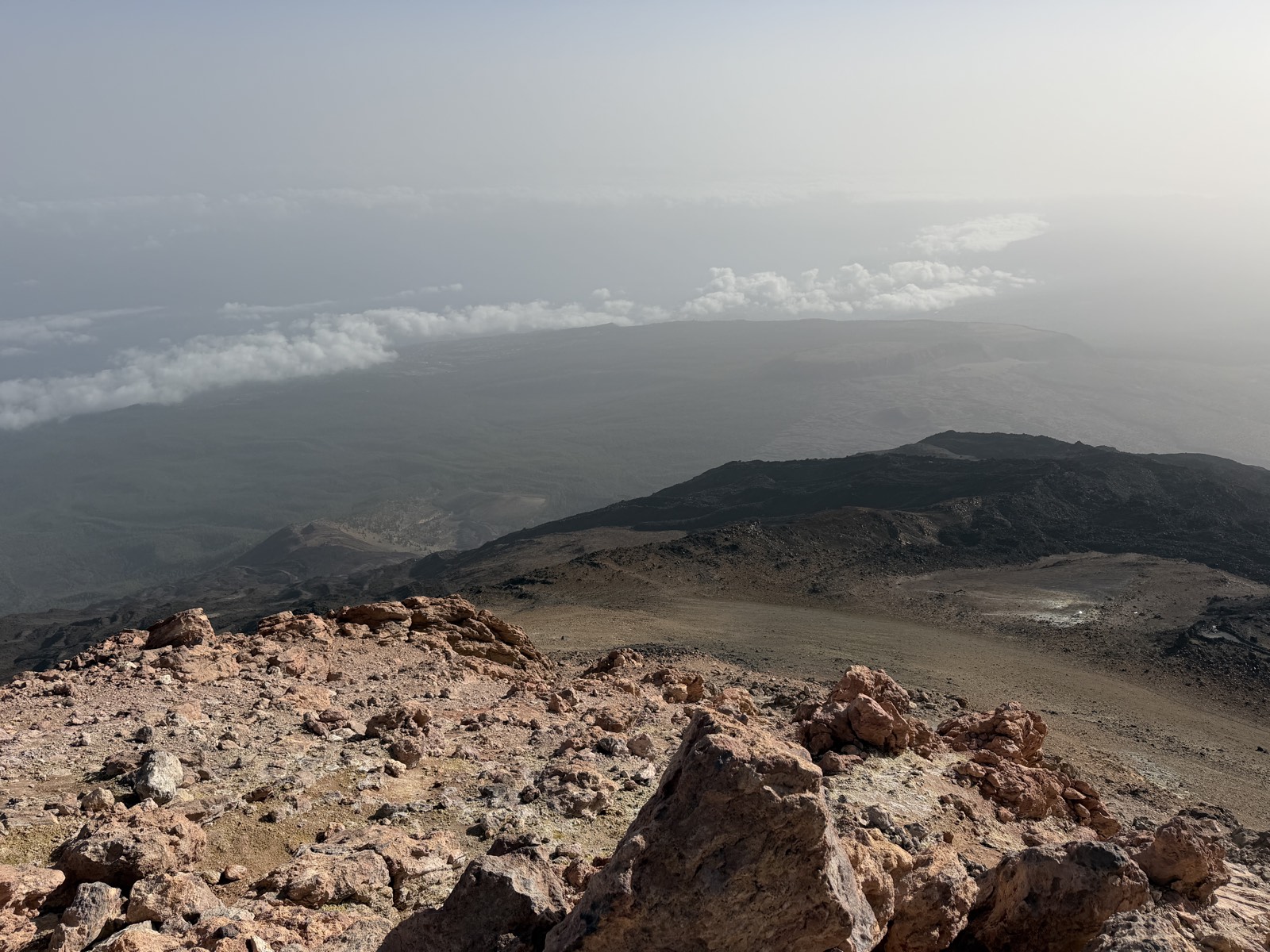
A calima is a Saharan dust event — an easterly airflow that carries fine dust the 300 km from Africa and hangs it over the Canaries for anywhere from a day to a week. During a strong one, the sky turns milky orange, temperatures jump, and the summit’s famous long views shrink to a bright haze. My own July 2026 photos show a mild version: the sunrise was still spectacular, but the horizon dissolved into soft amber murk rather than a crisp line of islands.
At sea level calimas are most frequent and thickest in winter and early spring, but at the park’s altitude the pattern flips: summer dust travels high in the atmosphere, so July–September episodes touch the plateau and summit most often, and they tend to be hot and persistent. No season is immune and you can’t book around them; they show up on forecasts three to five days out (the AEMET app flags them explicitly). If one lands on your Teide day: the summit sometimes rides above the worst of the dust — most reliably with winter events, which hug lower altitudes — sunsets go an extraordinary blood-orange, and stargazing dims but rarely to zero. The casualty is the coastal panorama — if that’s the whole point of your trip, use whatever flexibility your tickets allow and shift by a couple of days.
The sea of clouds
The mar de nubes is the park’s signature phenomenon: the trade winds push moist Atlantic air against Tenerife’s north side, where it condenses into a cloud layer at roughly 600–1,500 m and stalls against the mountains. From the coast it’s an overcast day. From the caldera rim, 1,000 m above it, it’s an unbroken white ocean pouring over the ridgelines with the summit floating above.
You can’t book it, but you can play the odds:
- Season: the trade winds are steadiest from late spring to early autumn, so May to September gives the most frequent and best-formed cloud seas. Winter fronts produce them too — often more dramatic, spilling through the passes — but less predictably.
- Time of day: mornings are best. The layer is usually thickest and smoothest early, then breaks up or burns back through the afternoon. Driving up the TF-21 from La Orotava or the TF-24 from La Laguna between 8 and 10 a.m., you punch through the cloud into sunshine — one of the best moments of any Teide trip.
- Where from: anywhere on the caldera’s north rim works; the La Crucita area on the TF-24 and the miradores above La Orotava are reliable. From the summit itself you look down on the whole layer with the coastline dissolving underneath it.
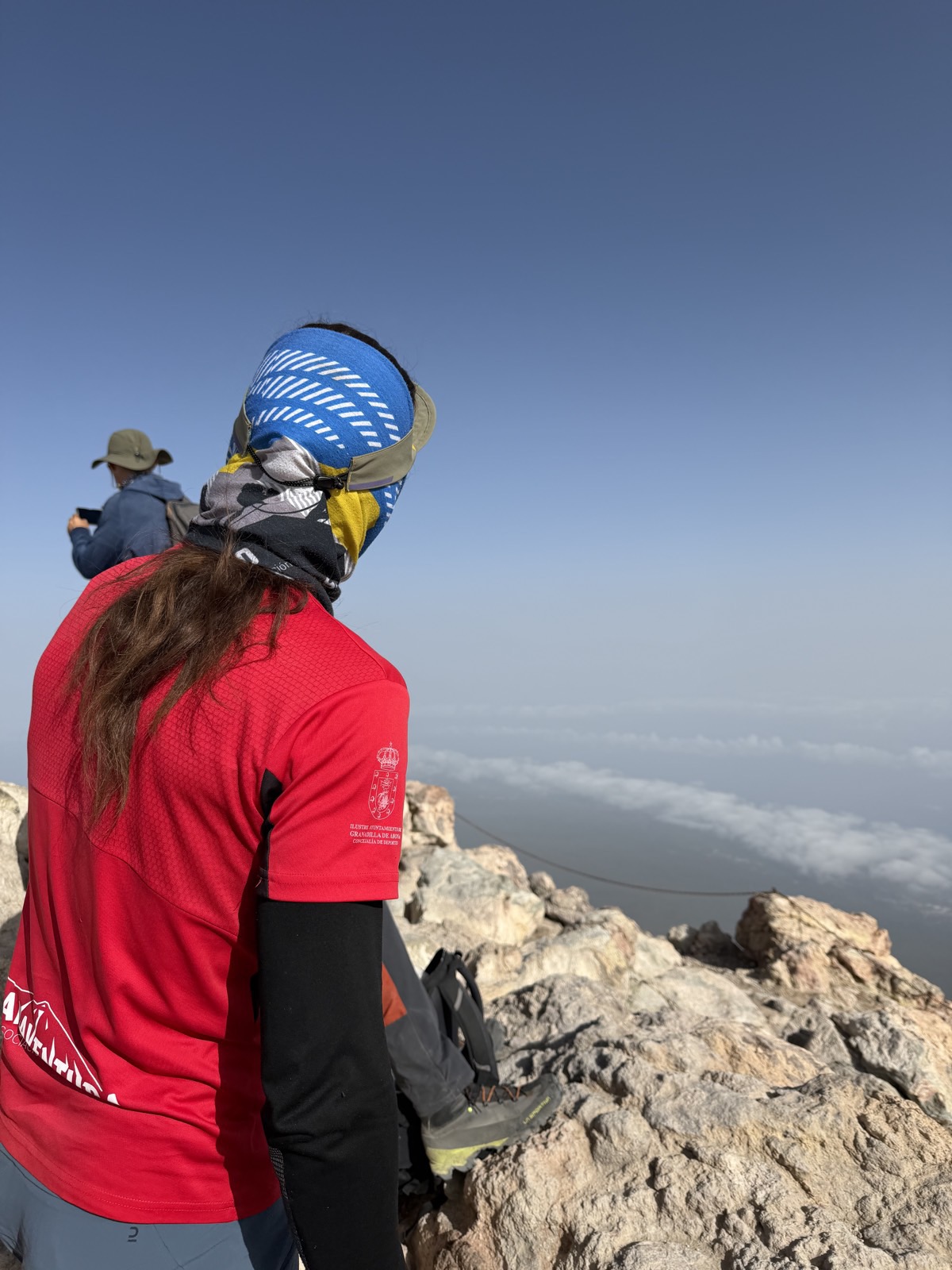 Above the trade-wind cloud layer at dawn. The clouds sit at 600–1,500 m; the summit clears them by two kilometres.
If you come up for the evening instead, the same layer swallows the sunset colours from below — and once it’s dark, the altitude and the legally protected skies make the park one of the best stargazing sites in Europe. The stargazing guide covers moon phases and the best laybys.
Best time of day
Whatever the month, the day has a rhythm worth planning around:
- Dawn (hikers and tour sunrises): coldest, emptiest, best light. Summit sunrise needs either the overnight hike, a night at Altavista, or a licensed sunrise tour.
- 9:00–11:00: the cable car opens at 9 a.m. year-round, and the first two hours are the calmest — wind tends to build through the day, and morning slots are the least likely to be cancelled. Coach tours start arriving from about 10:30.
- 11:00–15:00: peak everything. Full car parks at the Roques de García and Montaña Blanca, queues at the base station, harsh flat light for photography.
- 15:00 to last ascent: crowds thin markedly. Last ascent is 4 p.m. in winter, stretching to around 5:40 p.m. in high summer — check volcanoteide.com for the current timetable. Late-afternoon light rakes across the caldera and turns the rock gold; this is my favourite cheap upgrade to a Teide visit.
- After dark: the park never closes and entry is free. Sunset from the upper slopes and the night sky afterwards are worth the drive on their own.
If you’re relying on public transport, note that the daily rhythm is set for you: Titsa runs one bus a day each way into the park — the 342 from Costa Adeje and the 348 from Puerto de la Cruz — arriving late morning and heading back mid-afternoon. Check current times at titsa.com, and see the getting to Teide guide for the details.
When things sell out: a booking-pressure calendar
This matters more in 2026 than it used to, because access rules have changed. Entry to the national park itself remains free, but since 19 January 2026 the regulated summit trails carry an eco-fee booked through the Cabildo’s Tenerife ON platform — for the final Telesforo Bravo trail (no. 10) to the crater it’s €15 for non-residents on daytime slots, less for Canary residents, free for Tenerife residents and under-14s. The permit’s old home, reservasparquesnacionales.es, handed booking fully to Tenerife ON on 1 September 2025 and now simply redirects you there; new dates are released on Mondays at 7 a.m. Canary time with a booking window of up to 56 days (extended from 28 in March 2026). Rules have shifted twice in two years, so treat any third-party summary — including this one — as a starting point and confirm on the official platform. The summit permit guide walks through the current process step by step.
How far ahead you need to book, based on the current pattern:
| Period | Summit permit (trail 10) | Cable car | Notes |
|---|---|---|---|
| Christmas–New Year | Gone almost the moment slots release | Book 2–4 weeks ahead | Snow closures can scupper plans anyway |
| Easter week | Released slots go within hours | Book 2–4 weeks ahead | The single worst week for crowds |
| May–June | Days to a couple of weeks | A few days ahead is usually fine | Easiest all-round booking |
| July–August | Release-day booking strongly advised | Book 1–2 weeks ahead; sunrise/sunset experiences further out | I booked my July slot the morning it released |
| September–October | Days to a couple of weeks | A few days ahead | Second-easiest window |
| November–early December | Usually straightforward | Short notice fine | Weather is the constraint, not demand |
The cable car (€42 return for non-resident adults, €21 for children 3–13) rarely sells out weeks ahead outside the peaks, but the good time slots do — if you want 9 or 10 a.m., book as soon as your plans firm up. If the permit is gone for your dates, the standard workaround stands: guided summit ascents carry their own permit allocations, and both official Volcano Teide tours and the operators on our tours page bundle the crater access with the cable car. And if you can’t or won’t do any of that, La Rambleta and the Pico Viejo viewpoint — no permit needed — still give you 95 per cent of the view.
Frequently asked questions
What is the coldest month on Mount Teide?
January and February are coldest: at cable-car-base altitude (2,350 m) the long-term averages are daytime highs around 7–8°C and overnight lows near 1°C, with two to three snow days a month. On the summit at 3,715 m, subtract another 8–9°C and add wind chill — daytime temperatures below freezing are normal in a cold spell. Brilliant sunshine flatters the numbers, but pack proper winter layers.
Can you see snow on Teide in summer?
Realistically, no. Snow is essentially unknown at Izaña from June to September, and while stubborn patches from a heavy winter can linger in shaded gullies on the summit cone into late spring, they’re gone by high summer. If snow-on-the-volcano is your goal, aim for late January to March and build in flexible days, because falls are unpredictable and roads close immediately afterwards.
Is Teide worth visiting on a cloudy day at the coast?
Usually yes — often it’s the best day. The typical trade-wind cloud sits between about 600 and 1,500 m, and the park floor starts at 2,000 m, so a grey morning in Puerto de la Cruz frequently means sunshine and a sea of clouds up top. The exception is a genuine weather front (rain at the coast, wind everywhere) or a calima, when the whole atmosphere turns hazy. Check a summit webcam before you write the day off.
When do Teide summit permits sell out?
For Easter, Christmas–New Year and August, effectively on release day — new dates open Mondays at 7 a.m. Canary time with a window of up to 56 days, and peak-date slots go within hours. In shoulder months you’ll often find slots one to three weeks out; in November you may get away with days. If your dates show nothing, a guided ascent with permit included is the reliable fallback.
Does the cable car run all year?
Yes — it opens at 9 a.m. year-round, with the last ascent at 4 p.m. in winter and about 5:40 p.m. in high summer. But it closes, at any time of year, when wind or ice make operation unsafe, and winter closures are common enough that you should never leave Teide for the last day of a winter trip. When the operator cancels, tickets are moved or refunded; check the day’s status on volcanoteide.com before driving up.
What is a calima, and should I change my plans if one is forecast?
A calima is Saharan dust carried over the Canaries on easterly winds, lasting one to several days and possible in any month — winter events are densest at the coast, while summer dust arrives higher up and reaches the park more often. It turns the sky milky, buries the long-distance views and pushes temperatures up. If your priority is the panorama across to La Gomera and Gran Canaria, shift your visit if you can. If not, go anyway — the summit sometimes rides above the dust, and calima sunsets are extraordinary.
Is May or October better for visiting Teide?
They’re near-equals, and both beat the summer peak. May has longer days, marginally better sea-of-clouds odds and the tail end of the spring flowering in the caldera — the red tajinaste spikes usually peak from mid-May into June. October has warmer nights, calmer booking pressure and slightly higher chances of dramatic post-frontal clarity. If stargazing matters, October’s earlier sunsets mean you needn’t stay up as late.