Stargazing on Mount Teide: Tours, the Observatory and DIY Spots
Teide National Park sits above the clouds, above most of the weather and above almost all of Tenerife’s light pollution — which is why professional astronomers built an observatory here and why the Starlight Foundation certified the park as a stargazing destination. This guide covers the three ways to experience it: a daytime tour of the Teide Observatory, an organised evening stargazing trip, or simply driving up with warm clothes and parking at a dark layby. I climbed Teide overnight in July 2026, and the four hours of Milky Way before the sky began to pale were as memorable as the sunrise itself.
Why Teide is one of the best stargazing sites on Earth
Three things line up here that almost never coincide somewhere you can reach in a hire car.
Altitude above the inversion layer. The trade winds push a near-permanent deck of cloud against Tenerife’s northern slopes at roughly 1,000–1,500 m. The caldera floor of Las Cañadas sits at 2,000–2,300 m — above that deck. The cloud sea below you doesn’t just look spectacular; it physically traps the humidity, dust and coastal light pollution underneath it. On a clear night the resorts of the south coast simply vanish beneath a lid of cloud.
Legally protected skies. The Canary Islands have had a “Sky Law” (Ley 31/1988) since 1988, regulating outdoor lighting, flight paths and radio interference to protect the astrophysical observatories on Tenerife and La Palma. There is no public street lighting anywhere inside the national park.
Certification to back it up. In 2013 Teide National Park was certified by the Fundación Starlight as both a Starlight Tourist Destination and a Starlight Reserve — the first UNESCO World Heritage Site to receive the tourist-destination certification. You can see the current list of certified destinations on the Starlight Foundation’s official site. In practical terms the certification means accredited Starlight guides, sky-quality monitoring and lighting rules, not just a marketing sticker.
The result: on a moonless night at 2,300 m you’ll see the Milky Way’s core structure with the naked eye, and the Andromeda galaxy as a smudge without binoculars.
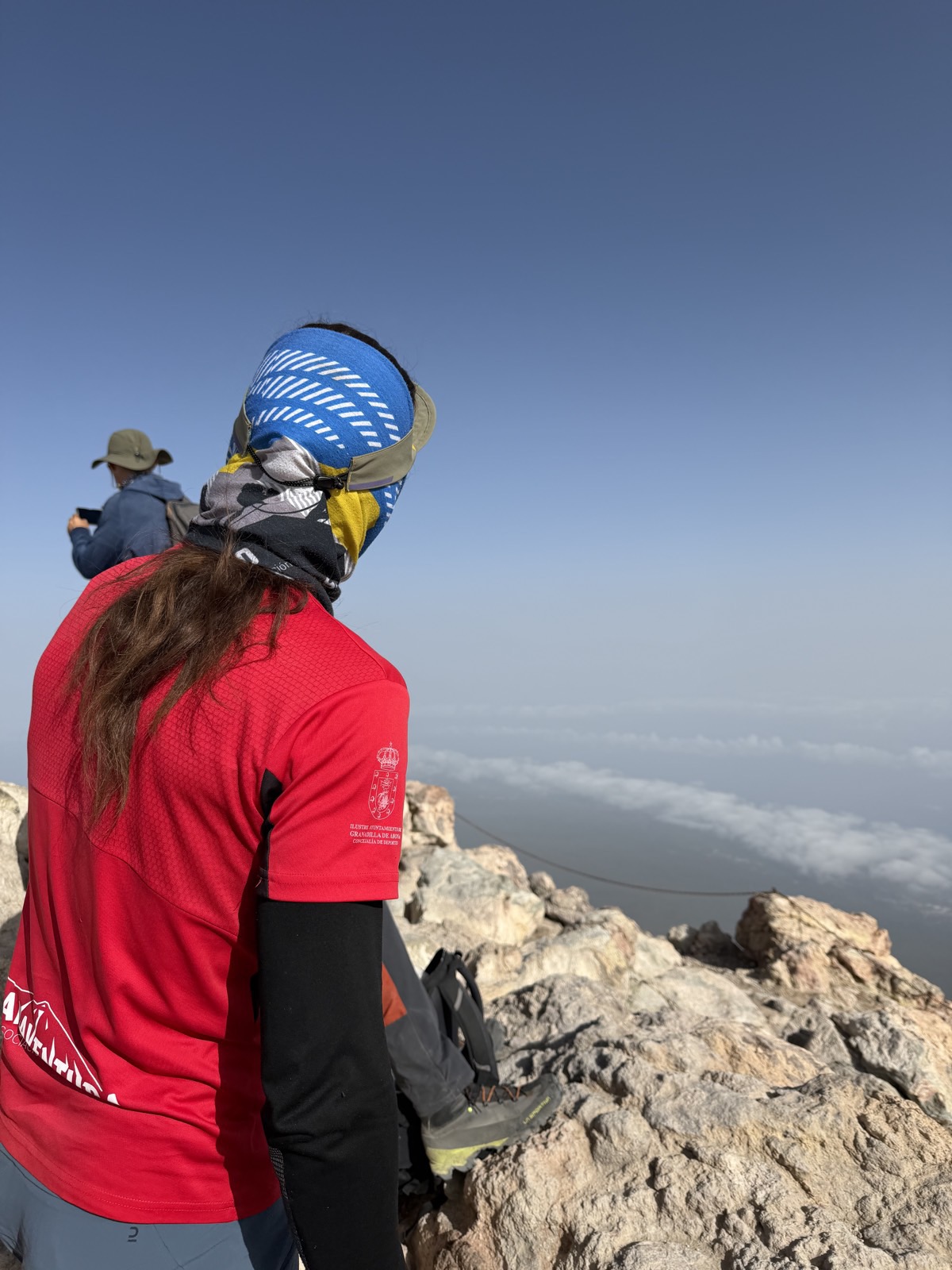 The inversion layer from above — everything that ruins stargazing at sea level is trapped under that cloud deck.
The Teide Observatory: visiting by day
The Observatorio del Teide sits at Izaña, at about 2,390 m on the ridge east of the caldera, reached from the TF-24 (the La Laguna road). Run by the Instituto de Astrofísica de Canarias (IAC), it’s one of the world’s most important sites for solar astronomy — the same stable air that gives you sharp stars at night gives astronomers sharp images of the sun by day. That’s why public visits are daytime only; the professional domes are working at night and are not open to tourists.
Guided daytime visits are operated by Volcano Teide (the same company that runs the cable car). As of mid-2026:
- Price: from €21 per adult; children aged 8–16 go free; under-8s are not admitted on the standard tour (a separate family version takes younger children).
- Duration: about 1.5 hours, typically including a look inside a working telescope dome and solar observation through portable instruments.
- Languages: English tours run daily; Spanish, German and French on set days.
- Logistics: you need your own car. The meeting point is the observatory access gate at km 1 of the TF-514 (the turning off the TF-24 at Izaña), and you’re asked to arrive 30 minutes before your slot; the facilities are a further 2 km drive inside the gate.
Check current times and book on volcanoteide.com — slots are limited and this is a popular add-on for people already driving the TF-24, which is arguably the prettiest of the three roads into the park (more on the routes in the guide to getting to Teide).
If you want the observatory and an evening of stargazing, the official Astronomic Tour (from €109, about 8 hours) combines an afternoon observatory visit with telescope observation after dark.
Organised stargazing tours: formats and what they cost
Evening tours are the sensible choice if you don’t have a car, don’t fancy mountain driving in the dark, or want telescopes and a guide who can explain the sky. The better tours use Starlight-accredited guides and serious kit — on a good night you’ll see Saturn’s rings, Jupiter’s moons and a globular cluster or two, none of which the naked eye can resolve.
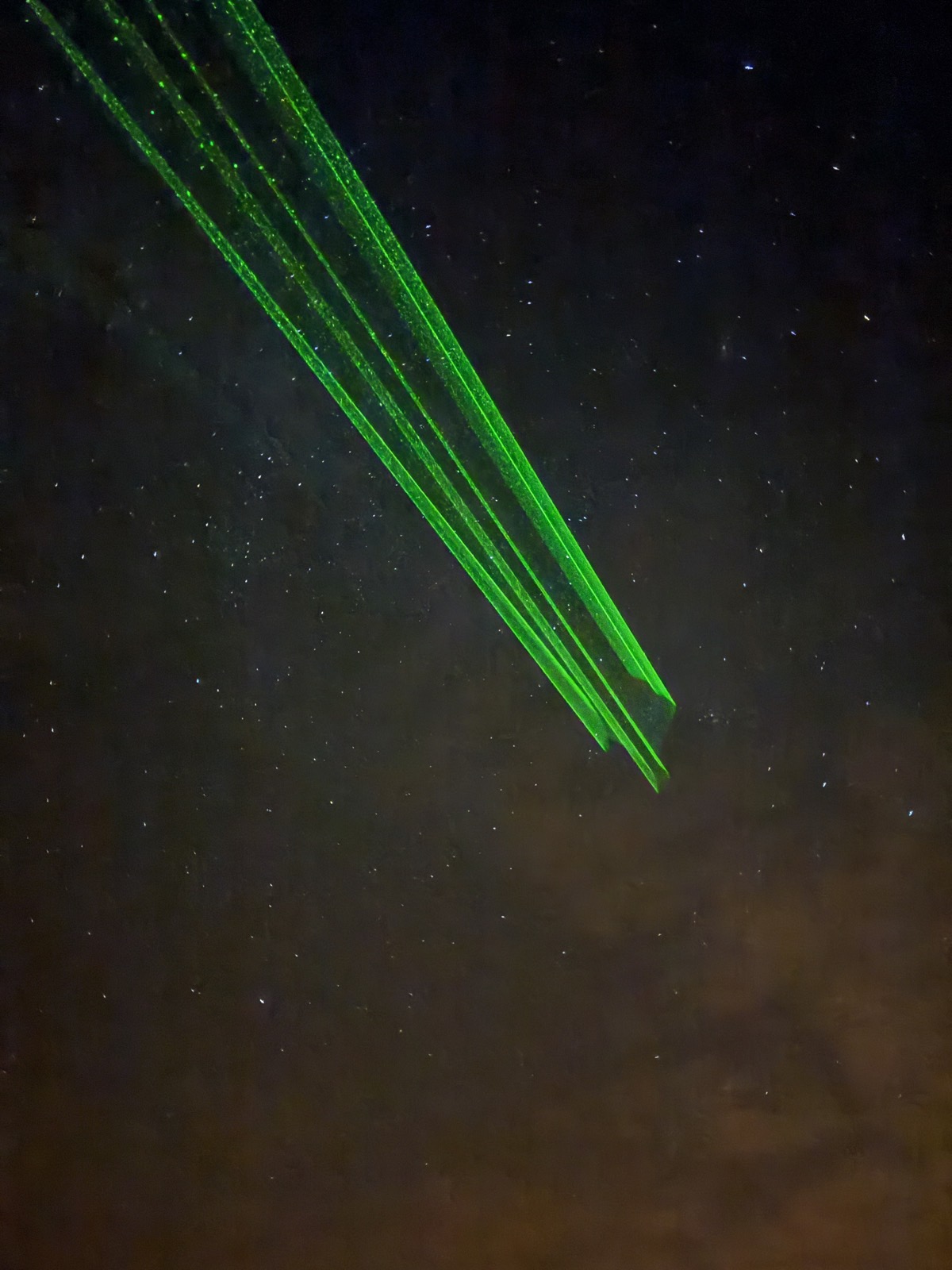 The guide’s green laser during our July 2026 night on the mountain — it makes following constellation lines effortless, even for complete beginners.
Rough shape of the market in 2026, using the official Volcano Teide products as the baseline:
| Tour format | Duration | From (adult) | What you get |
|---|---|---|---|
| Astronomical Observation on Teide | ~1 h | €42 | Telescope session at the cable car base station, no transport |
| Mount Teide Night Tour | ~6.5 h | €77 | Coach from the resorts + guided observation |
| Teide By Night | ~9 h | €89 | Hotel pick-up, sunset, guided stargazing |
| Astronomic Tour | ~8 h | €109 | Daytime observatory visit + evening telescopes |
| Sunset & Stars | ~8 h | €182 | Out-of-hours cable car ride for sunset at 3,555 m, then telescopes |
Prices are “from” rates taken from the operator’s site in July 2026 and move with season and options — treat them as ballpark and check the live price before booking. On marketplaces like GetYourGuide you’ll also find independent operators running small-group stargazing with astrophotography from around €35–€50, and sunset-plus-dinner-plus-telescopes formats typically in the €60–€120 range depending on what’s bundled. Read the inclusions line by line: “dinner” can mean a picnic box, and some cheaper tours observe from below the park boundary rather than inside it.
The Sunset & Stars format is the premium pick for a reason: the cable car doesn’t normally run after late afternoon, so riding up to La Rambleta at 3,555 m for sunset is something you simply cannot do independently. Watching the shadow of the volcano stretch across the sea of clouds — the famous triangular shadow — and then descending to telescopes below is a genuinely unrepeatable evening. See the tours listing for the stargazing trips featured on this site, and the sunrise and sunset guide for what the shadow phenomenon actually looks like and when it happens.
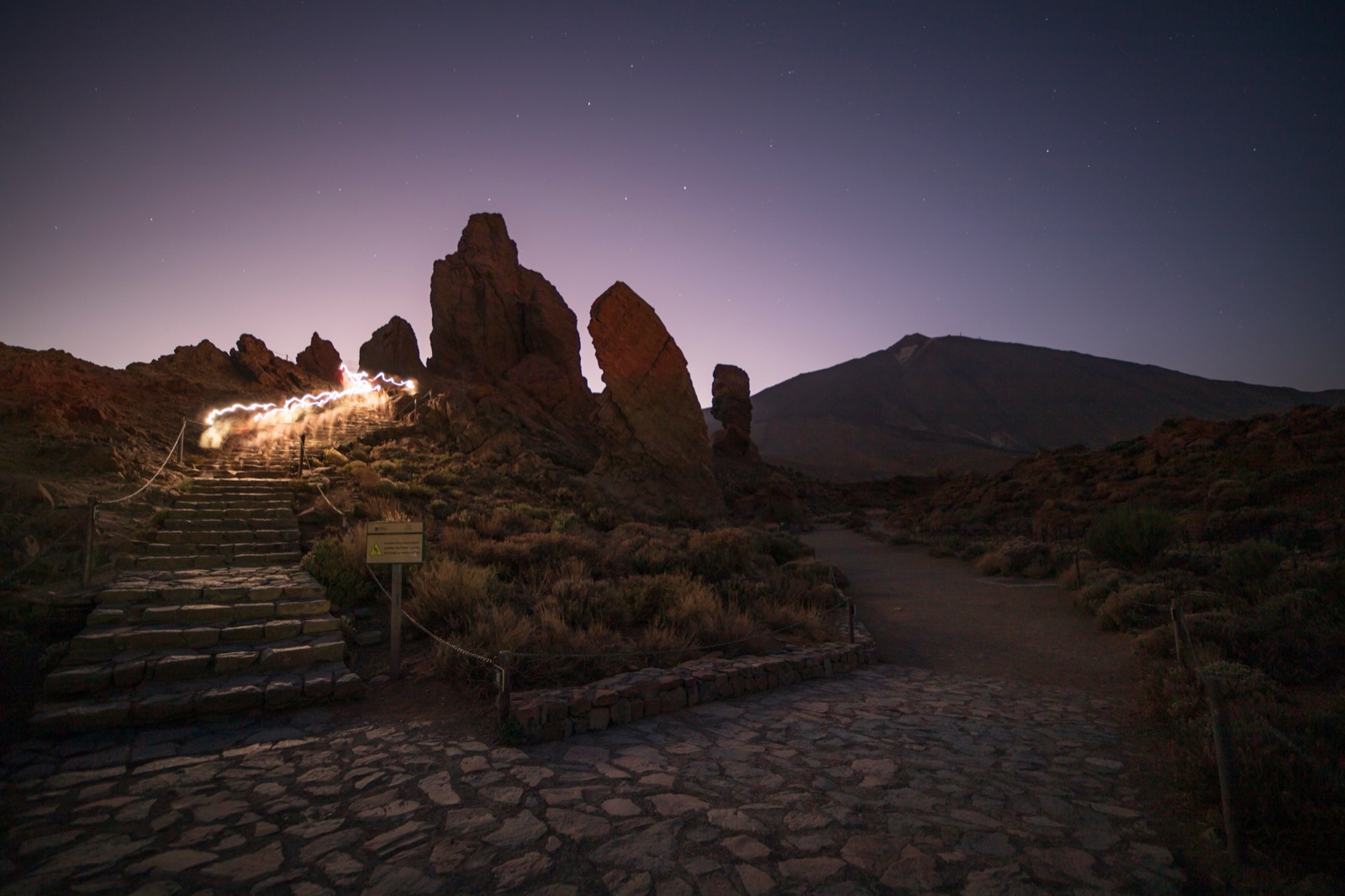 Nightfall at Roques de García — organised trips time the telescope stop for full darkness.
Plan around the moon, not just the weather
The single biggest factor in what you’ll see — bigger than season, bigger than which layby you pick — is the moon.
- For the Milky Way and deep-sky objects: aim for the window from about four days before to four days after new moon. A bright moon washes the sky to grey and you’ll lose the galactic core entirely.
- If your dates are fixed: check moonrise and moonset times, not just the phase. Even at a fat gibbous moon there’s often a fully dark window before it rises or after it sets. Any planetarium app or timeanddate.com will give you the times for Tenerife.
- Full moon isn’t wasted: the caldera under moonlight is extraordinary — you can walk without a torch and the rock formations look like a film set. Some operators run specific moonlight tours. You just won’t see many stars.
Tour operators run every night regardless — nobody refunds you for a full moon, so do the five minutes of homework yourself.
DIY stargazing: driving up on your own
Here’s the part that surprises people: the roads through Teide National Park (TF-21, TF-24, TF-38) are ordinary public roads, park entry is free, and as of mid-2026 there is no gate and no curfew. You can drive up at 11pm, park at a layby, and have one of Europe’s darkest accessible skies to yourself.
Important caveat for 2026 and beyond: access rules are in flux. A new management plan for the park was approved in December 2025, and the Cabildo of Tenerife has announced a phased rollout: visitor controls at busy viewpoints including Minas de San José and Roques de García from summer 2026, access controls at the three main road entrances and pre-booked parking quotas by the end of 2026, and a shuttle-bus network from four points around the island (Puerto de la Cruz, La Laguna, Costa Adeje and Puerto Santiago) planned from 2027. Hiking-permit bookings already run through the island’s Tenerife ON platform, and fees for the summit trails were introduced in January 2026. None of this stopped night-time car access when I visited in July 2026, but check the current situation shortly before your trip rather than trusting any guide written months earlier — this one included.
The best spots
- Mirador de las Minas de San José (TF-21): the classic. A lunar landscape of pale pumice with two large car parks on either side of the road, wide horizons and no obstructions. This is where many of the commercial tours set up their telescopes, which tells you something.
- Llano de Ucanca (TF-21, near Roques de García and the Parador): a huge flat plain with the silhouettes of Los Roques for foreground interest — the best choice if you’re shooting photos rather than just looking.
- El Portillo area (junction of TF-21 and TF-24): convenient if you’re coming from the north, slightly lower and sometimes a touch hazier.
- Montaña Blanca car park (TF-21, km 40.2): where summit hikers set off at night. Less of a viewpoint, but if you’re doing the night ascent you get world-class skies for the whole climb anyway.
The park also has a self-guided astronomical trail: seven information panels at viewpoints between El Portillo and Chío — Minas de San José (which has two), Tabonal Negro, Roques de García, Los Azulejos, Llano de Ucanca and the Juan Évora museum car park — put up by the tourism board to help you find your way around the sky.
One more DIY option worth knowing: the Parador de Las Cañadas del Teide is the only hotel inside the park. Stay a night and the dark sky is literally at the door — no late-night mountain driving at all.
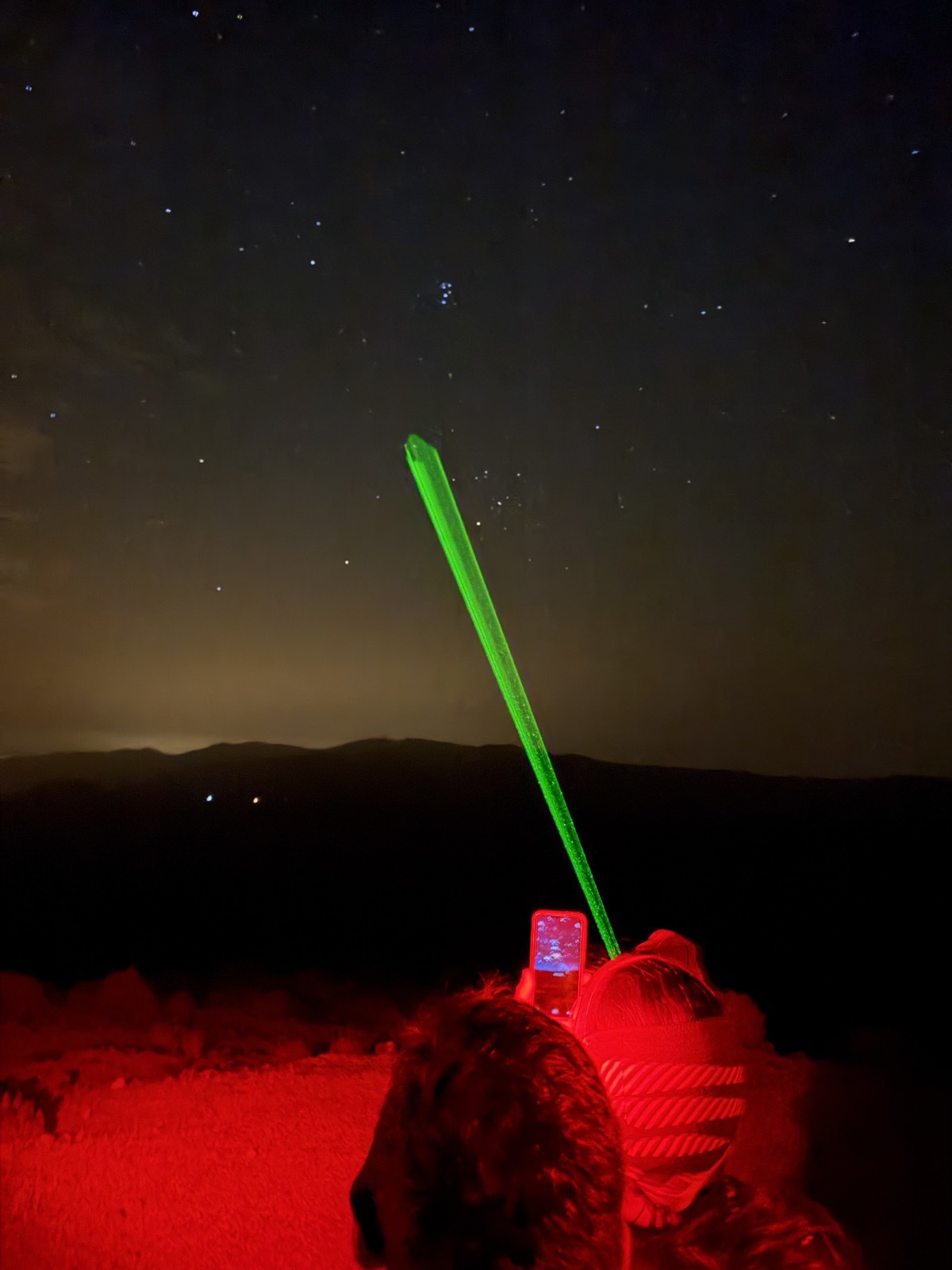
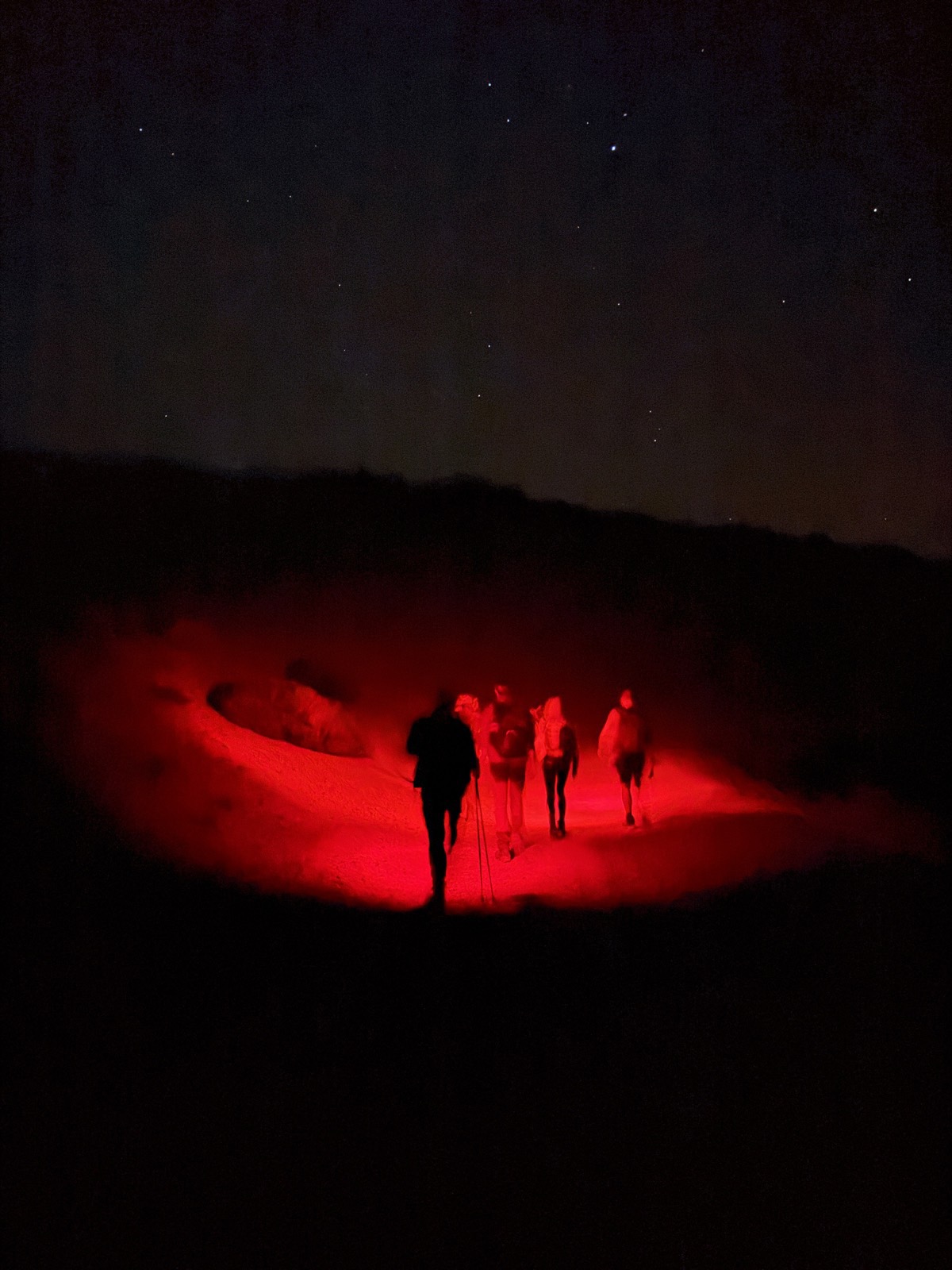 Red light preserves your night vision — and everyone else’s. White head torches at a stargazing layby make you unpopular fast.
Etiquette and practicalities
- Park fully inside the laybys and car parks — never on verges, which damages the protected terrain and earns fines.
- Kill your headlights as soon as you’ve parked, and use a red-light mode on your torch. Your eyes need 20–30 minutes to fully dark-adapt, and one blast of white light resets the clock for everyone nearby.
- There is no public transport at night. The Titsa buses into the park — the 342 from Costa Adeje and the 348 from Puerto de la Cruz — run once a day each way and leave the park mid-afternoon (timetables at titsa.com). DIY stargazing means a car, full stop.
- No drones (prohibited in the national park), no fires, take everything back down with you.
Winter versus summer skies
Teide delivers year-round, but you’re looking at different skies. For the broader weather picture month by month, see the best time to visit Teide.
April to September — Milky Way core season. The bright galactic centre in Sagittarius and Scorpius rises in the small hours in spring; by July–August it’s high in the south soon after full darkness. On my July summit night the core was unmistakable by 1am, arcing over the southern horizon while we climbed. The Perseids (peaking around 12–13 August) land conveniently in the warmest, most stable season.
October to March — winter clarity. The core is gone, but transparency after cold fronts is superb: Orion, the Pleiades, Sirius blazing over the caldera, and the Geminids in mid-December, which are often the year’s best shower. The trade-offs are real cold, occasional snow and ice, and the fact that the TF-21 and TF-24 do close temporarily after heavy snowfall.
Any season: watch for calima, the Saharan dust haze that occasionally reaches the island and turns the sky milky. If the forecast mentions it, a tour with big telescopes salvages more of the night than the naked eye will.
Photography basics that actually work up here
No exotic gear needed, but a tripod is non-negotiable.
- Starting settings: widest lens you own, aperture wide open (f/2.8 if you have it), 15–20 seconds, ISO 3200, manual focus. Focus by magnifying a bright star on live view, not by trusting the infinity mark.
- Keep exposures under ~20 seconds on a wide lens or the stars trail. Longer than that needs a star tracker.
- Shoot RAW and fix white balance later; the sky here comes out surprisingly warm-toned on auto.
- Foregrounds make the shot. Los Roques from Llano de Ucanca, the pale pumice mounds at Minas de San José, or the summit cone itself from the TF-21 laybys all beat a horizon-only frame.
- Modern phones are respectable braced on a rock or mini tripod — 30-second night modes capture the core cleanly.
Cold kills lithium batteries fast; keep spares in an inside pocket.
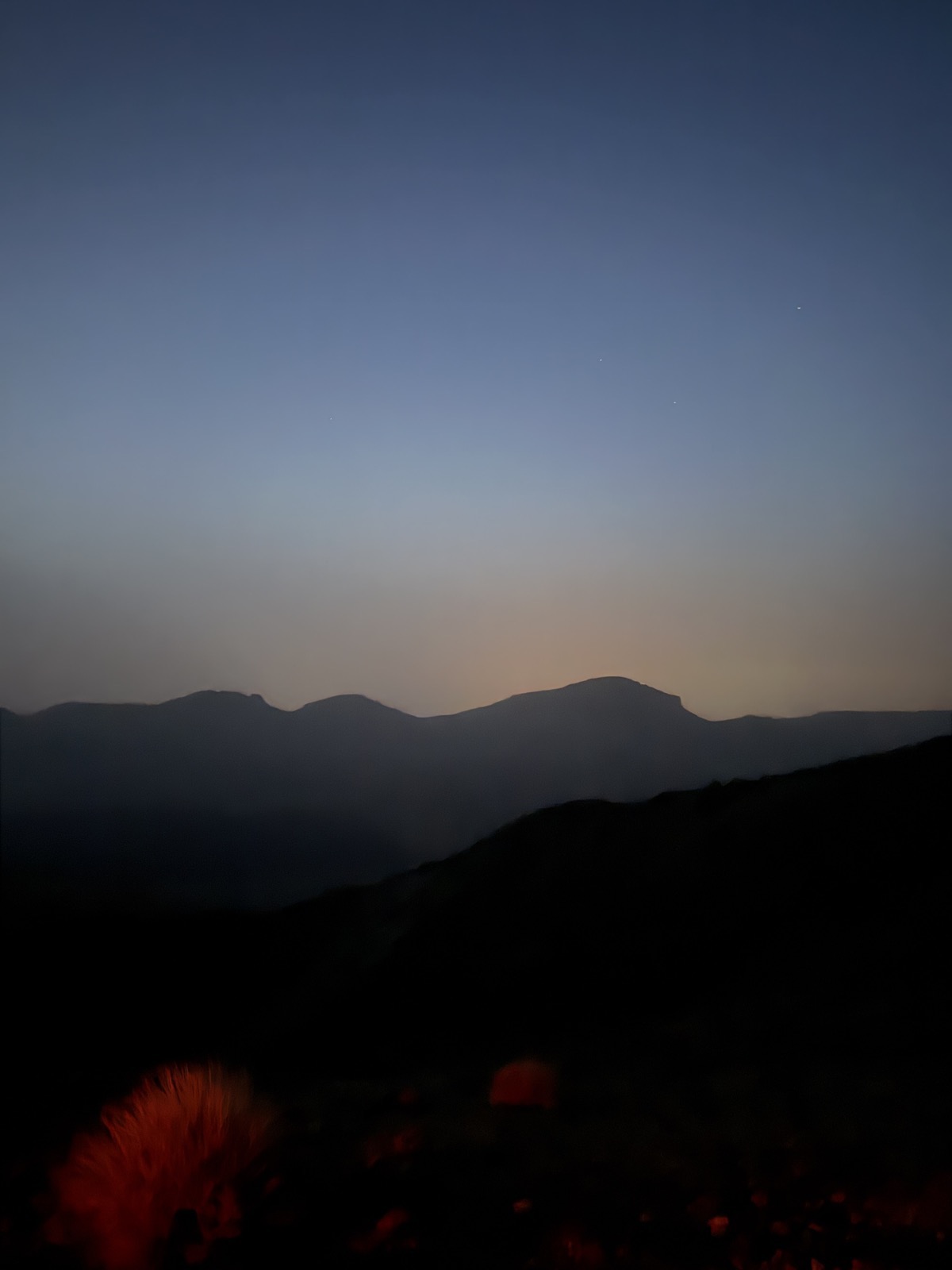 Stay until the end and the night hands over to this — first light over the ridges, with Venus usually the last thing to fade.
The cold, the altitude and the drive back down
Do not judge the night by the beach. In August it can be 26°C in Costa Adeje and 10°C at Minas de San José at 1am — with wind, feeling far less. On my July climb it was fleece weather at the Montaña Blanca layby at midnight and close to freezing with wind chill near La Rambleta before dawn. In winter, sub-zero temperatures at the laybys are normal. Bring an insulated jacket, hat and gloves in any month, plus a flask of something hot.
The altitude itself (2,000–2,400 m at the laybys) is mild — at most a slight headache for some people — but factor it in if you’re combining stargazing with a summit hike, which tops out at 3,715 m and needs a permit booked well ahead (see the summit permit guide).
The drive down needs more respect than the drive up. You’ll descend roughly 1,500 vertical metres of switchbacks in the dark, then punch through the cloud layer where visibility can drop to 20 metres in seconds. Use engine braking in a low gear rather than riding the brakes — brake fade on the TF-21’s hairpins is a real thing — take the fog slowly, and fill the tank before you come up, because there are no petrol stations inside the park. In winter, check for ice and road-closure notices before setting off at all.
Frequently asked questions
Can you stargaze in Teide National Park without a tour?
Yes. As of mid-2026 the park’s roads are open public roads with no gate or night curfew, entry is free, and parking at the designated laybys such as Minas de San José costs nothing. You need your own car, warm clothes and a red-light torch. Be aware that the Cabildo has announced viewpoint controls and parking reservations rolling out through 2026, with a shuttle-bus network planned from 2027, so check the current access rules shortly before you travel.
How much do Teide stargazing tours cost?
The official Volcano Teide products ran from €42 for a one-hour telescope session at the base station to €182 for the Sunset & Stars trip with out-of-hours cable car, with coach-based night tours at €77–€109, as of July 2026. Independent small-group tours on marketplaces like GetYourGuide start around €35–€50. Prices change with season, so treat these as ballpark figures and check the live listing.
When is the best time of year for stargazing on Mount Teide?
Any clear, moonless night is good, but April to September is Milky Way core season, with the galactic centre highest on July and August evenings. Winter offers superb transparency, Orion and the December Geminids, at the cost of serious cold and occasional snow closures on the park roads. Whatever the month, plan within a few days of the new moon if you want the faint stuff.
Can you see the Milky Way with the naked eye from Teide?
Yes, easily, on a moonless night — including dark-lane structure in the core between April and September. The park sits above the inversion layer that traps light pollution and moisture near the coast, and the Canary Sky Law restricts lighting island-wide. Give your eyes 20–30 minutes without white light and the sky keeps getting deeper the longer you look.
Does the cable car run at night?
No — regular cable car services finish in the late afternoon. The only way to be at La Rambleta (3,555 m) after dark without hiking is a special out-of-hours product like the official Sunset & Stars tour. If you want the details of normal daytime operations, see the cable car guide.
Do you need a permit to stargaze in the park?
No permit is needed to drive in, park at the laybys and watch the sky. Permits are only required for specific trails — most notably the Telesforo Bravo summit path, which is limited to 200 people a day and booked through the official Tenerife ON platform, with a fee introduced in January 2026 for most non-resident hikers.
Is the Teide Observatory open at night?
No. It’s a working research facility, and public tours run in daytime only — appropriately, since Izaña is one of the world’s leading solar observatory sites. Daytime guided visits cost from about €21, children under 8 aren’t admitted on the standard tour, and you need your own car to reach the gate on the TF-514. For telescopes after dark, book an evening stargazing tour instead.
How cold does it get at night, even in summer?
Expect roughly 8–15°C at the 2,100–2,400 m laybys on an August night, often feeling colder in the wind, and close to freezing near the upper cable car station before dawn even in July. In winter, sub-zero temperatures with snow and ice are routine. An insulated jacket, hat and gloves belong in your boot in every month of the year.